
PROTOCOL
Surgical wound healing by secondary intention versus primary and delayed primary closure: systematic review protocol
Lim Way Wern B,1,2 Chikhal R,1,2 Chua W,1,2 Arundel C,3 Long J,1,2 Staniland T,2,4 Totty JP,1,2 Smith G,1,2 Chetter I1,2
Plain English Summary
Why we are undertaking this research: After certain operations, wounds are intentionally left open to heal from the bottom up. This is known as surgical wound healing by secondary intention (SWHSI). SWHSI can take a long time to heal, need frequent dressing changes, greatly impact quality of life and may require further interventions. However, it may be possible to close the wound at the time of surgery (known as primary closure) or some time later (known as delayed primary closure). We don’t know which of these method leads to the best outcomes for patients.
What we aim to do: We will bring together and analyse the best evidence (randomised controlled trials) in adults that compare leaving the wound open to heal by secondary intention and wound closure (either primary or delayed primary). We will search major databases measuring time to wound healing, and how many wounds are healed at 6 and 12 months. Other outcomes will also be measured, including infection, pain, need for antibiotics, hospital admission, changes in treatment or re-operation, progression to amputation, death, quality of life and healthcare use. We will combine and analyse the results from all the different trials, and assess the quality and certainty of the trials. The findings of this study should clarify whether leaving a surgical wound open to heal from the bottom up is better than immediate closure or delayed wound closure, support better decision making, inform guidelines and highlight where further research is required.
Abstract
Background: Surgical wound healing by secondary intention (SWHSI), where wounds remain open after an operation and are allowed to close gradually from the bottom upwards, is common, resource-intensive and associated with prolonged healing durations and complications. Alternative closure methods such as primary closure and delayed primary closure may offer better outcomes; however, the current evidence base remains uncertain with no formalised guidelines to aid decision making. This study aims to determine the efficacy of alternative closure methods.
Methods: This is a protocol for a systematic review and meta-analysis. Databases that will be searched include MEDLINE, Embase, CINAHL and CENTRAL with no date restrictions applied. Only randomised controlled trials enrolling adults aged 18 and above published in the English language will be included. Two reviewers will independently screen and assess the eligibility of manuscripts and extract data using a template, with disagreements being resolved by consensus or a third reviewer. Risk of bias will be evaluated using the Cochrane Risk of Bias 2.0 (RoB 2). A meta-analysis will be carried out if appropriate; if not, a narrative synthesis will be provided. If substantial heterogeneity is observed, subgroup analysis will be performed to explore potential sources of variability.
Discussion: This study will aim to synthesise the best available evidence comparing SWHSI with primary and delayed primary closure. The results from this study aim to support decision making, inform guidelines and highlight where further research is required.
Prospero registration: CRD420251070682
Background
Every year 4.4 million surgical procedures are undertaken under the National Health Service (NHS) in England.1 Incisions made during these procedures are ideally closed immediately after surgery, known as primary closure or healing by primary intent. In some circumstances the incision is left open and allowed to heal from the base upwards through granulation, followed by re-epithelialisation and contraction known as healing by secondary intent.2 Surgical wound healing by secondary intention (SWHSI) may be indicated where primary closure is not feasible due to being dirty or contaminated, containing active infection, having insufficient tissue for closure, or where a wound has subsequently dehisced following primary closure.3,4
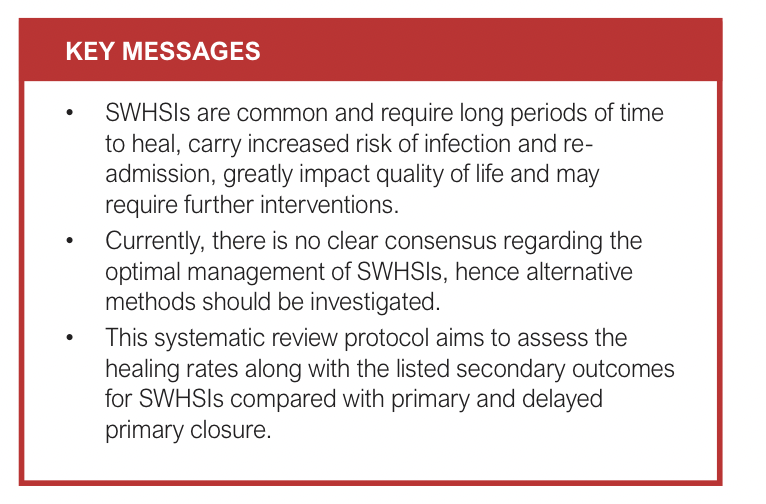
SWHSIs are relatively common, affecting 4.1 per 10,000 and account for approximately one-quarter of all surgical wounds.3,5 Among all the procedures involving SWHSI, abdominal wounds (33.6%) and lower extremity wounds are the most common, often following colorectal (42.8%) and vascular (11.8%) surgeries.5 SWHSIs carry a considerable economic burden estimated to be approximately £1501–£2383 per patient per month. Costs are predominantly driven by factors including increased rates of hospital re-admission at 24.7%, increased rates of infection at 32.1% and requirement for further interventions at 16.8%.3,5,6 SWHSIs also lead to significantly longer healing times with a median time of approximately 3 months, with only 81.4% of wounds achieving closure within 12 months along with reduced tissue strength and poorer cosmetic outcomes.7–9 A cohort study in 2019 demonstrated that the management of SWHSIs remains heterogenous, with the most commonly used dressing being hydrofibre or spun hydrocolloid dressings followed by wound contact dressings and negative pressure wound therapy at 41.7%, 32.8% and 29.0%, respectively.6
Several surgical techniques may be used as alternatives to SWHSI. A randomised controlled trial in 2025 showed that 34.7% of wounds were classed as clean or clean-contaminated, indicating that they may have been suitable for alternative closure methods.10 Primary closure, or healing by primary intention, involves the immediate approximation of wound edges using sutures, staples or adhesives and is the most commonly used method for clean wounds.11 In contaminated wounds, delayed primary closure or healing by tertiary intention may be more suitable and involves leaving wounds open for a period of time post-surgery with dressing changes, before closing the wound with sutures or staples.12 In contaminated wounds, primary closure was associated with a significantly higher rate of infections, wound dehiscence and a longer hospital stay compared with delayed primary closure.13-15 However, primary closure eliminates the need for dressing changes and their associated costs along with a shorter hospital stay compared with delayed primary closure.16
SWHSIs remain open for many months and frequently require multiple interventions, resulting in significant disease burden to patients and substantial healthcare costs.17 Therefore, alternative wound closure methods should be considered where possible. The aim of this systematic review is to determine the effectiveness of SWHSI versus primary or delayed primary closure to aid decision-making as well as identify gaps for further research.
Methods
This systematic review is prospectively registered on the International Prospective Register of Systematic Reviews (PROSPERO) database with the reference: CRD420251070682. The Preferred Reporting Items for Systematic Reviews and Meta-analyses Protocols (PRISMA-P) guidelines will be used as a guide for this systematic review protocol.18
Search strategy
Databases will include EMBASE, OVID Medline, CINAHL and Cochrane Central Register of Controlled Trials (CENTRAL). There will be no time frame constraints applied to the search.
The search strategy will be developed in conjunction with a certified medical librarian to formulate the search strategy. Search terms will be designed around SWHSI and alternative closure methods using both free-text keywords and medical subject headings to maximise sensitivity.
Search terms will include – but are not limited to – “secondary intention”, “secondary intent”, “primary closure”, “primary intention”, “delayed closure”, “delayed primary” and “tertiary intention”. The preliminary search strategy is attached in the appendix. Randomised controlled trial filters used were obtained from the InterTASC Information Specialists’ Sub-Group.19
Inclusion/exclusion criteria
Randomised controlled trials published in the English language, comparing surgical wound healing by secondary intention with either primary closure or delayed primary closure will be included. Papers that compare different management options for SWHSIs that received closure at a later date will also be included.
Exclusion criteria include wounds left open without the intention of healing (such as stoma and gastrostomy sites), surgery that does not involve an incision on the skin surface, split skin donor graft sites, nail avulsions, dermal substitute use, oral surgeries such as cavities from dental extractions, staged closure methods, stoma reversal wounds, operations of the eye, wounds from minor dermatological or plastic procedures (such as removal of warts, skin tags and punch biopsies) and chronic wounds such as pressure ulcers or foot ulcers that are non-surgical in origin (diabetic foot ulcers that underwent debridement in theatre will be included).
Only trials with participants over the age of 18 will be included. SWHSIs may be planned through preoperative recruitment or in patients with a pre-existing SWHSI.
Study selection
The Covidence web tool will be used for study screening, selection, data extraction and quality assessment.20 Duplicates will be removed manually after automatic duplicate identification. Two authors will independently screen all titles and abstracts to remove those that do not fit the inclusion criteria. The remaining full-text manuscripts will then be reviewed and data extracted following the same process. Any disagreements will be resolved through mutual consensus between the two review authors, or by arbitration by a third reviewer if required.
Data extraction and management
A standardised data extraction template developed by the review team will be used. Patient demographics, interventions, comparators, wound location, operation type and study outcomes will be collected. Conflicts of interest, funding source, specialty, healthcare setting, study design, sample size and other biases will also be collected where available. Raw data will be extracted from the manuscripts into the Covidence built-in data extraction template and Review Manager (RevMan®).20
Assessment of methodological quality
The Cochrane Risk of Bias 2.0 (RoB 2) tool for randomised trials will be used to evaluate risk of bias in this study rated as ‘high’, ‘low’ or ‘some concerns’. Risk of bias due to missing results will be assessed if a minimum of 10 studies are included for meta-analysis through funnel plots and Egger’s test.
The Grading of Recommendations, Assessment, Development and Evaluations (GRADE) system will be implemented to evaluate the degree of certainty of evidence supporting each outcome, which may be labelled as either ‘very low’, ‘low’, ‘moderate’ or ‘high’. Two reviewers will conduct the risk of bias assessment independently, with any disagreements resolved by mutual consensus or arbitration by a third reviewer.
Outcomes
There will be two primary outcomes for this systematic review. The first is time to healing, defined as time to complete re-epithelialisation of the wound. A large multicentre randomised trial used Kaplan–Meier time-to-event methods over a 12-month follow-up period and demonstrated that healing continues throughout this period, with a substantial proportion of wounds remaining unhealed at 12 months.10 Accordingly, the second primary outcome will be the proportion of wounds healed at 6 and 12 months post-procedure, representing a milestone at which delayed or non-healing wounds may prompt reassessment, re-intervention, or alternative treatments.
Secondary outcomes will include clinical events as a composite outcome, which are: requirement for antibiotic treatments, rate of hospital admission or discharge, treatment status including reasons for dressing or treatment failure or change, re-operation rates including closure interventions, progression to amputation and death. We will also evaluate wound infection rates, wound pain, quality of life and resource usage such as consultations, support and other costs and frequency and type of wound dressing changes.10
Statistical analysis
Meta-analyses will be conducted using RevMan® for studies with comparable methodologies and outcomes. Continuous outcomes will be reported using mean differences or standardised mean differences (SMD) depending on uniformity. Dichotomous outcomes such as antibiotic treatments and death will be presented as risk ratios (RR) or odds ratios (OR) with their respective 95% confidence intervals (CI). Time to event outcomes will be reported using hazard ratios (HR) with their corresponding 95% CIs. Separate meta-analyses will be conducted where feasible, otherwise a narrative synthesis will be provided.
Heterogeneity will be assessed using the X2 test and the I2 statistic if clinical homogeneity criteria are acceptable. A random-effects model will likely be implemented, considering the anticipated heterogeneity in surgical indication, wound features and interventions. If heterogeneity is minimal, a fixed effects model will be implemented. The I2 statistic cut-off for heterogeneity that will be used is 60%. If substantial heterogeneity is observed, subgroup analysis will be performed to explore potential sources of variability. Stratification will be based on key clinical features such as surgical wound characteristics, closure method and level of contamination or presence of infection. Additionally, to mitigate the anticipated heterogeneity of results, we will aim to stratify the results by operation type and wound location where extracted data permit, allowing for context-specific interpretation of results.
Discussion
There is no clinical consensus on the management of SWHSIs, which reflects a lack of evidence in the literature. A qualitative study in 2020 showed that clinicians had variable knowledge of SWHSI treatments and frequently opted for negative pressure wound therapy, despite a lack of evidence supporting its use.6
There is evidence to suggest that a high proportion of SWHSIs were suitable for alternative methods of wound closure.10 To date, there are no comprehensive reviews comparing SWHSIs to primary or delayed primary closure. A robust look at the evidence in this area will help inform future practice and improve patient outcomes surrounding wound healing.
Article DOI:
Journal Reference:
J.Vasc.Soc.G.B.Irel. 2026;5(2):94-97
Publication date:
February 13, 2026
Author Affiliations:
1. Academic Vascular Surgery Unit, Hull York Medical School, Hull, UK
2. Hull University Teaching Hospitals, Hull, UK
3. York Trials Unit, Department of Health Sciences – Faculty of Science, University of York, York, UK
4. Library and Knowledge Services Hull University Teaching Hospitals, Hull Royal Infirmary, Hull, UK
Corresponding author:
Dr Bryan Lim Way Wern
Academic Vascular Surgery Unit, Hull York Medical School, Hull Royal Infirmary, Anlaby Road, Hull HU3 2JZ, UK
Email: bryan.limwaywern@ nhs.net