REVIEW
Application and outcomes of compression therapy for people living with lymphatic, venous and arteriovenous malformations: a scoping review
Cooper G, Rothwell D
Plain English Summary
Why we undertook the work: Compression therapy is commonly used to manage vascular malformations, but it is unclear how it is being used and how strong the evidence is to support its benefits. We reviewed the available research to understand how compression therapy is used, what outcomes have been reported and where further research is needed.
What we did: We searched five research databases for studies that reported the use of compression therapy in people with vascular malformations. Sixteen studies were included. We examined how compression therapy was used, the types of compression prescribed, the outcomes reported and the strengths and limitations of the available research.
What we found: Compression therapy was widely used, either on its own or alongside other treatments. Some studies reported improvements in areas such as the size of the vascular malformation, limb swelling and symptoms. However, there were considerable differences in the type, pressure and duration of compression used. Studies also measured outcomes differently, and much of the available evidence came from observational studies and individual or small groups of patient cases.
What this means: Compression therapy may provide benefits for people living with vascular malformations, but there is currently not enough evidence to determine the best type, pressure or duration of compression, or which patients are most likely to benefit. Better-quality research using more consistent approaches to compression therapy and measuring outcomes is needed.
Abstract
Objective: To map the available evidence on the use and reported outcomes of compression therapy for vascular malformations and identify gaps within the existing evidence base.
Methods: A scoping review was undertaken and reported in accordance with PRISMA-ScR. CINAHL, Cochrane, Embase, SPORTSDiscus and Ovid MEDLINE were searched for studies reporting compression therapy in people with vascular malformations. Screening was performed independently by two reviewers. Data were extracted and synthesised descriptively and thematically.
Results: Sixteen studies were included. Four themes were identified: (1) compression therapy is widely adopted despite limited evidence; (2) marked heterogeneity exists in compression prescription; (3) outcome measurement lacks standardisation; and (4) methodological weaknesses limit confidence in treatment effectiveness. Compression was used as a standalone intervention and within multimodal and procedural management. Potential improvements in lesion size, limb circumference and symptoms were reported; however, compression type, pressure and duration varied considerably. Objective and patient-reported outcomes were inconsistent, while observational studies and case reports predominated.
Conclusion: Compression therapy is widely used for vascular malformations, but evidence is insufficient to determine optimal prescription or which patients are most likely to benefit. Standardised compression protocols and outcome measures are required.
Introduction
Vascular anomalies represent a heterogeneous group of disorders involving abnormalities of the vascular and lymphatic systems. Presentations can be simple and isolated (slow-flow, fast-flow), multifocal (eg, lymphovenous) or syndromic (eg, Klippel–Trenaunay syndrome) requiring multidisciplinary management.1,2 Prevalence estimates range from 1.5% for congenital malformations which grow proportionally, to 10% for acquired malformations occurring due to damage later in life.3,4 The classification of vascular anomalies was first proposed by Mulliken and Glowacki5 and subsequently refined by the International Society for the Study of Vascular Anomalies (ISSVA),6 which distinguishes vascular tumours such as infantile haemangiomas from congenital vascular malformations. Congenital vascular malformations arise due to abnormalities in vascular development and include venous, lymphatic, capillary, arteriovenous and combined malformations.
Venous malformations represent the most common congenital vascular malformation and may range from small localised lesions to extensive disorders associated with pain, swelling, functional impairment, thrombosis, localised intravascular coagulopathy and psychosocial consequences.7-9 Lymphatic malformations occur most commonly in paediatric populations and may present as fluid-filled cystic lesions associated with swelling, infection risk and treatment complexity, particularly in microcystic disease.10,11 Owing to their chronic nature, vascular malformations frequently require lifelong monitoring and individualised management strategies.
Management depends on malformation subtype, anatomical location and symptom burden, with treatment options including sclerotherapy, embolisation, pharmacological therapies and surgery; while recurrence remains a common challenge.9,12 Compression therapy is frequently incorporated into management pathways to reduce oedema, improve venous and lymphatic return, and relieve symptoms.13,14 Proposed mechanisms by which compression therapy can benefit vascular malformations include reduced intravascular coagulation and blood stasis leading to reduced intravascular pressure, reduced oedema, increased comfort and protection from minor trauma.13,15,16
Despite widespread use, uncertainty remains regarding the evidence supporting compression therapy in people living with vascular malformations. Studies have reported the potential benefits for symptom control, limb volume, pain, function and quality of life, but substantial variation exists in compression prescription, outcome measures and reporting.13,14 Tools are available to evaluate compression materials and devices in lymphoedema and chronic venous disease,17 but little evidence is available to inform clinical prescription and evaluation, and consensus-based guidance regarding compression type, grade and duration of use is not available.
Understanding the available evidence can inform clinical decision-making, identify knowledge gaps and guide future research priorities. Accordingly, a scoping review was undertaken to map the current evidence relating to the application of compression therapy in people living with lymphatic, venous and arteriovenous malformations. Capillary malformations were not included in the initial search as these cutaneous malformations are unlikely to benefit from the proposed haemodynamic effects of compression therapy in the same way as venous and lymphatic malformations. The review question was: What is the current evidence on the application of compression therapy for people living with lymphatic, venous or arteriovenous malformations?
Methods
Design
A scoping review methodology was selected to systematically identify and map the extent, range and characteristics of available evidence examining the use of compression therapy for people living with lymphatic, venous, arteriovenous or mixed malformations. This approach was appropriate given the anticipated heterogeneity of the evidence across vascular malformation subtypes, compression therapy approaches, study designs and reported outcomes. The review was conducted using the methodological framework proposed by Arksey and O’Malley,18 with enhancements informed by Levac et al,19 comprising five stages: (1) identifying the research question; (2) identifying relevant evidence; (3) selecting evidence; (4) charting the data; and (5) collating, summarising and reporting the findings. Evidence selection and data charting were undertaken iteratively, and findings were synthesised using a descriptive numerical summary and thematic analysis. Reporting was guided by the Preferred Reporting Items for Systematic Reviews and Meta-Analyses Extension for Scoping Reviews (PRISMA-ScR; see (see Appendix 1 online at www.jvsgbi.com).20
Search strategy
A comprehensive search strategy was developed to identify published evidence relating to compression therapy in people living with vascular malformations. Searches combined controlled vocabulary and free-text terms relating to vascular malformation and compression therapy, adapted for each database using Boolean operators (AND/OR). Electronic searches were undertaken across five databases (CINAHL, Cochrane, Embase, SPORTSDiscus and Ovid MEDLINE) on 9 February 2026, covering the period from inception. A total of 417 records were retrieved before duplicate removal and screening. Conference abstracts identified through Embase were excluded prior to screening due to insufficient methodological detail and outcome reporting. Reference lists of included studies and relevant review articles were also searched to identify additional eligible evidence. An example of the completed database-specific search strategy is shown in (see Appendix 1 online at www.jvsgbi.com).
Eligibility criteria
Studies were eligible where participants of any age had a diagnosed lymphatic, venous, arteriovenous or combined/complex vascular malformation. Syndromic presentations associated with vascular malformations were also eligible where the underlying vascular anomaly was clearly described. Eligible interventions included compression garments, stockings or hosiery, flat-knit compression systems, compression bandaging, adjustable compression devices, intermittent pneumatic compression and other forms of sustained external compression. Compression could be used as the primary intervention or alongside other treatments provided information relating to its application or outcomes could be extracted. Evidence from any healthcare or self-management setting was eligible. Studies were excluded where they focused exclusively on acquired vascular conditions without congenital vascular malformation; secondary lymphoedema without vascular malformation; animal or laboratory research; compression therapy unrelated to vascular malformation management; or did not provide sufficient clinical information relating to the use of compression therapy.
Screening
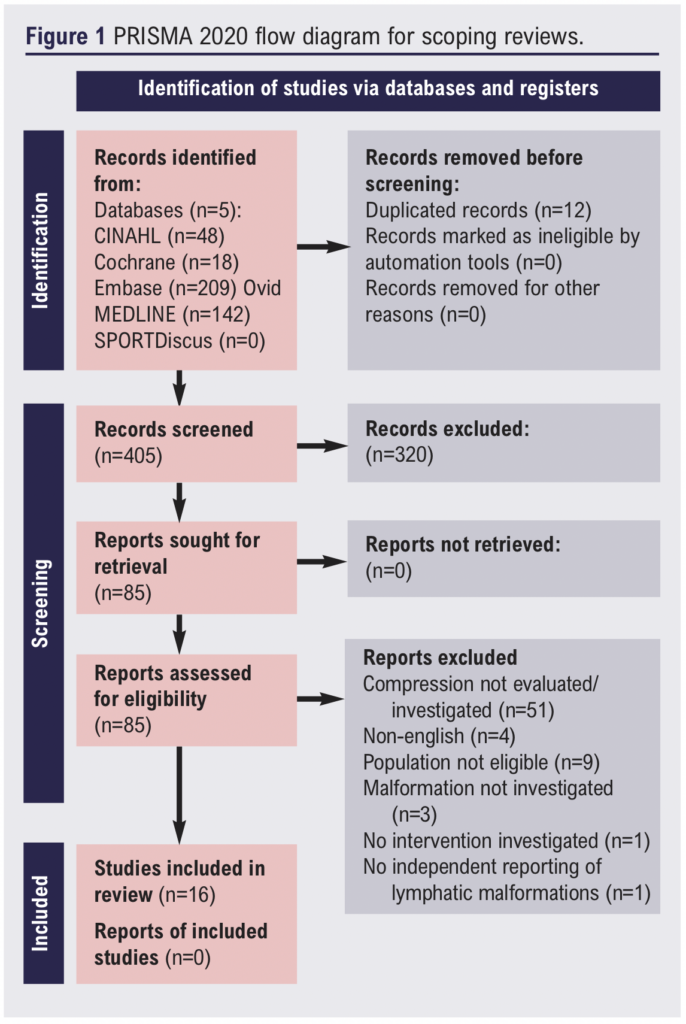
Evidence selection followed a two-stage screening process. Following duplicate removal, titles and abstracts were screened independently by two reviewers against the predefined eligibility criteria. Any disagreements were resolved through joint review and consensus. Potentially eligible records underwent full-text assessment to confirm vascular malformation subtype, use of compression therapy and sufficient information regarding its application or outcomes. Reasons for full-text exclusion were recorded. The study selection process is shown in the PRISMA-ScR flow diagram (Figure 1).
Data analysis
A structured, independent, iterative data-charting framework was developed to extract relevant information,19 which was collated and summarised to provide an overview of the current evidence landscape.18 Charting was performed independently by both reviewers. Data was limited to that provided in the published article only. The extracted study characteristics are presented in Table 1. A descriptive numerical summary was used to map publication characteristics, study designs, populations, vascular malformation types, compression approaches and reported outcomes. Evidence was then compared across included sources and organised into four analytical themes: (1) characteristics of compression therapy application; (2) objective and clinical outcomes; (3) patient-reported outcomes and experiences; and (4) methodological limitations and remaining evidence gaps. These themes are presented using an integrated findings and discussion approach, whereby descriptive findings are presented alongside interpretation of their implications for clinical practice and future research.

Findings and discussion
Characteristics of the included evidence
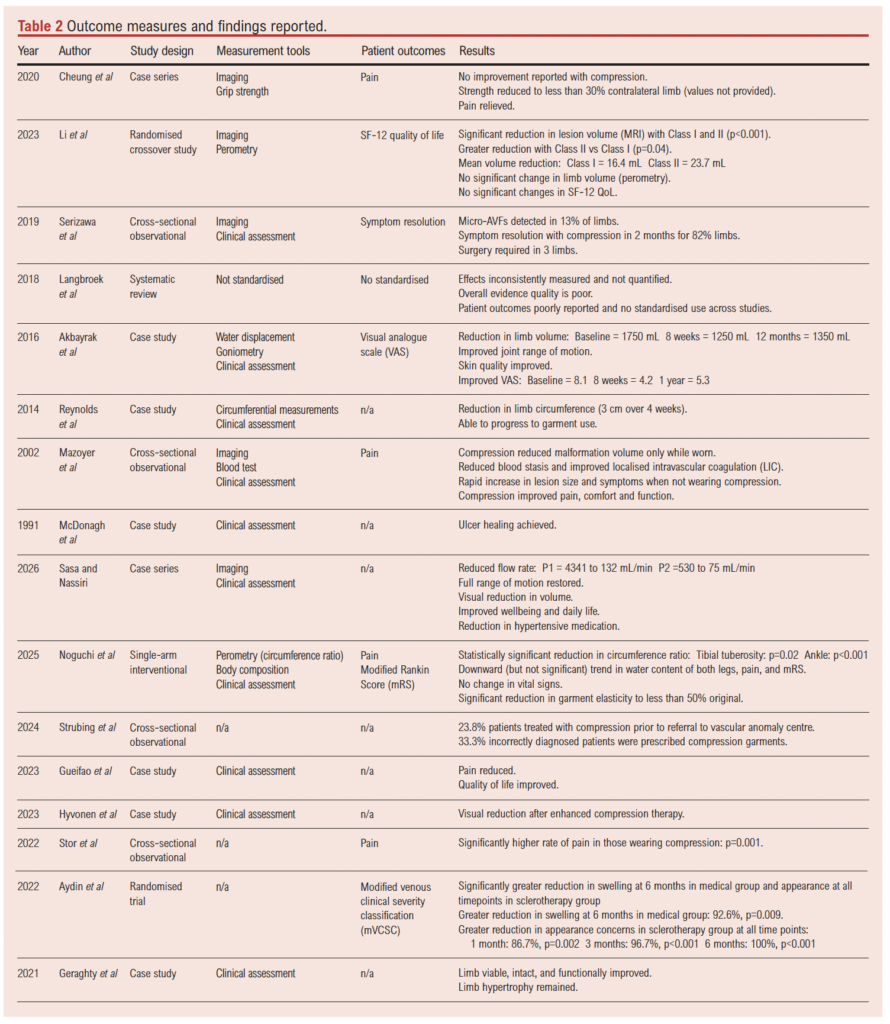
The 16 included studies were conducted across Europe (n=11), North America (n=2), Asia (n=2) and Oceania (n=1) (Table 1). The evidence base was dominated by case reports and series (n=8), followed by retrospective observational (n=4) and prospective interventional (n=3) studies. There was one systematic review of five case series.13 The prospective studies included a single-arm study,21 a randomised trial comparing garments with medication and sclerotherapy22 and a randomised crossover trial of class I (18–21 mmHg) and class II (23–32 mmHg) garments.14 Female participants comprised the majority in all studies reporting participant sex, except for case reports, and age ranged from 0 to 82 years, with no studies reporting ethnicity or socioeconomic characteristics. Venous (n=7) and mixed (n=7) malformations were the most frequent, followed by arteriovenous (n=6). Among the eight case reports were mixed (n=5) and arteriovenous malformations (n=3). Compression therapy was used as a standalone intervention (n=5), before or after procedural interventions (n=5), and as part of multimodal conservative management (n=2), providing the basis for the themes presented below. Table 2 summarises the objective and patient-reported outcomes across the included studies.
Theme 1: Compression therapy is widely adopted despite limited evidence
Compression therapy was widely adopted across the included studies, although relatively few evaluated its independent effectiveness. Five investigated compression therapy as a standalone intervention,14,16,21,23,24 two within multimodal conservative management,25,26 and five before or after procedural interventions, including embolisation, surgery and wound care.27-31 None included a no-treatment control group, preventing determination of compression therapy’s independent contribution to treatment outcomes.
Among the studies evaluating compression therapy as a standalone intervention, several reported improvements in objective clinical outcomes. Continuous compression garments were associated with reduced transmural pressure, parietal distension and improved patient comfort,16 whilst Reynolds23 reported a reduction in limb circumference of approximately 3 cm following four weeks of compression bandaging. Serizawa et al24 similarly reported improvements in the appearance of micro-arteriovenous malformations, although two participants remained symptomatic and subsequently required surgery. Li et al14 demonstrated significant reductions in venous malformation volume, whereas Noguchi et al21 reported reductions in affected limb circumference following six months of compression garment use. However, despite these objective improvements, neither study demonstrated significant improvements in patient-reported outcomes, including quality of life or pain. Collectively, these findings suggest potential improvements in objective outcomes, particularly lesion size and limb circumference, while evidence for symptoms and quality of life remains less consistent. The limited use of validated patient-reported outcomes is particularly important for a therapy that may require prolonged or lifelong use.
When compression therapy was incorporated into multimodal management, attributing improvements specifically to compression was not possible. Akbayrak et al,26 Gueifão et al25 and Hyvönen et al30 combined compression therapy with other conservative pharmacological or procedural interventions. Although improvements in limb volume, skin condition, function and symptom severity were reported, the contribution of compression therapy could not be distinguished, with similar attribution problems surrounding procedural interventions. Sasa and Nassiri28 reported substantial reductions in arteriovenous malformation flow following cyanoacrylate embolisation, whilst McDonagh et al31 and Geraghty and Allaway29 described reductions in oedema and successful ulcer healing using four-layer compression bandaging alongside wound care and vascular intervention. In contrast, Cheung et al27 found that compression garments, propranolol and sclerotherapy were ineffective in managing fibroadipose vascular anomaly before definitive surgery, suggesting that compression therapy may not provide similar benefit across all vascular malformation subtypes. Outcome measurements of strength, range of movement and walking ability were notably absent across all studies, and it is not clear at present whether compression garment use can improve characteristics important to daily function in people with vascular malformations.
Evidence from observational studies further illustrates the uncertainty surrounding treatment effectiveness. Stor et al32 reported greater pain among patients wearing compression garments, particularly females and those with lesions involving muscle or bone, although a range of malformation localities and tissue involvements were included and it is possible that pain influenced the prescribing of compression garments, limiting the application of this finding. Strübing et al33 demonstrated that compression therapy was frequently prescribed before referral (23.8%) and following specialist assessment (43.2%), but did not evaluate clinical outcomes. Likewise, Aydin et al22 reported similar symptomatic improvement between compression therapy, medical treatment and sclerotherapy in patients with telangiectasia and reticular veins, although cosmetic outcomes favoured sclerotherapy. These findings are consistent with the systematic review by Langbroek et al,13 which concluded that compression therapy may reduce pain, oedema, intravascular coagulation and minor trauma, but that the evidence remains heterogeneous and predominantly observational. Overall, compression therapy was routinely incorporated into the treatment of vascular malformations, but observational designs, frequent use of co-interventions and clinical heterogeneity limited confidence in its independent effectiveness. This uncertainty also highlights the considerable variation in compression therapy prescription, explored in the following theme.
Theme 2: Marked heterogeneity exists in compression prescription
Compression therapy prescription varied considerably across studies, limiting identification of the most appropriate strategy. Garments were the most frequently reported compression intervention, being used alone in nine studies.14,16,21,22,24,25,27,32,33 Bandaging alone was reported in two studies,29,31 whilst four studies combined garments with bandaging, intermittent pneumatic compression or adjustable wraps.23,26,28,30
Reporting of prescribed compression pressure was inconsistent. Five studies reported compression pressure or class with corresponding pressure values,14,21–24 while two described garments by compression class only.25,30 Where pressure was reported, the most frequently prescribed range was 20–30 mmHg. The British Standard (BS 661210) for compression garments defines 14–17 mmHg as class 1, 18–24 mmHg as class 2 and 25–35 mmHg as class 3. While higher levels of compression have been shown to reduce lesion size,14 a trade-off between comfort and physiological benefit is required to ensure patient compliance, but limited reporting of compliance prevents recommendations being derived. Importantly, while treatment duration ranged from one month to over 12 years, with 6–8 months most reported, five studies did not report how long garments were worn for,13,16,27,32,33 despite published recommendations to renew garments every six months to maintain elasticity and therapeutic benefit.21
The chronic nature of vascular malformations makes compliance an important outcome measure for informing clinical practice, particularly when prescription can prevent medical or surgical intervention. Only one study reported compliance relating to two different garment classes worn for 4 weeks each.14 Satisfactory compliance was reported (~12 hours per day) without any change in patient reported outcomes, but longer-term studies are needed to support clinical decision making.
Garment characteristics were inconsistently described; only one study explicitly evaluated flat-knit garments,14 two reported custom-made garments21,30 and only Serizawa et al24 specified circular-knit garments. Circular-knit garments provide support for regularly shaped limbs, flat-knit provide stronger containment of fluid where chronic oedema is present, and custom-made are used in unique cases which, despite providing useful insight, have limited potential for generalisation. Cost implications differ with garment type and consistent reporting is necessary to enable practical consideration. The findings of Li et al14 further highlight the importance of consistently reporting compression class and pressure due to the physiological effect. Overall, heterogeneity in garment type, compression class, interface pressure and treatment duration, together with inconsistent reporting and limited comparative evidence, precluded identification of an optimal compression strategy for specific vascular malformation subtypes.
Theme 3: Outcome measurement lacks standardisation
Considerable heterogeneity existed in the objective measures used to evaluate compression therapy (Table 2). Fifteen of the 16 studies reported at least one objective outcome.14,16,21–33 However, 16 different objective measures were identified, including magnetic resonance imaging (MRI), computed tomography (CT), ultrasound, clinical assessment, limb circumference, perometry, water displacement, body water content, range of motion and physiological measures. MRI, CT and clinical assessment were the most frequently reported measures.14,16,24,27,29,31 This variability in outcome measurement limited comparison between studies and reduced confidence in comparing treatment outcomes.
A similar lack of standardisation was evident in patient-reported outcomes. Although all studies reported some form of subjective assessment, including quality of life, pain, functional outcomes or symptom improvement, the use of validated measures was limited. Li et al14 used the 12-Item Short Form Health Survey (SF-12) while Akbayrak et al26 used a visual analogue scale to assess pain. The remaining studies relied on study-specific symptom reporting, functional assessments or descriptive clinical observations.16,21–25,27–32 Pain was the most frequently reported patient outcome, being assessed in nine studies.14,16,21,22,24–27,32 Importantly, only one study included mental health status as a measurement of patient reported outcomes.28 Overall, inconsistent objective and patient-reported outcome measures limited comparison between studies and confidence in evaluating the effects of compression therapy. This could be addressed by developing and validating a vascular malformation-specific patient reported outcome measure in future work which could also support the development of consensus-driven standardised outcome measures for monitoring the condition in the long term. Based on the limitations identified in this review, a standardised measurement set should include objective, functional, patient reported outcomes, garment characteristics, use and adherence, and clinically important measures to support consistency across future studies and enable generalisation of findings.
Theme 4: Methodological weaknesses limit confidence in treatment effectiveness
The methodological characteristics of the included studies further limited confidence in the reported effectiveness of compression therapy. Although 16 studies were identified, the evidence base was dominated by lower-level study designs, as previously reported.13 Eight studies were case reports or series,23,25–31 four were observational16,24,32,33 and three were interventional.14,21,22 There was only one randomised crossover trial that directly evaluated compression therapy14 and one systematic review synthesised the available evidence, although this study only included five retrospective case series.13
Across the included studies, methodological limitations were common. Sample sizes were generally small, with many studies reporting single patients or a limited number of participants, impacting generalisability. Furthermore, compression therapy was frequently delivered alongside pharmacological, surgical or interventional treatments, making it difficult to isolate its independent therapeutic effect. Follow-up ranged from one month to over 12 years, limiting comparison of treatment durability and longer-term outcomes. Noguchi et al21 reported a significant reduction in garment elasticity after six months of use and recommended replacement at this interval, with implications for future study design and clinical practice. Participant characteristics were inconsistently reported. Although most studies described age and sex, none reported ethnicity or socioeconomic characteristics and the impact of vascular malformations across society is not clear, limiting the design of equitable approaches. In addition, there was no direct exploration of whether treatment response differed according to vascular malformation subtype, lesion severity or anatomical location. Consequently, it remains unclear which patient groups are most likely to benefit from compression therapy.
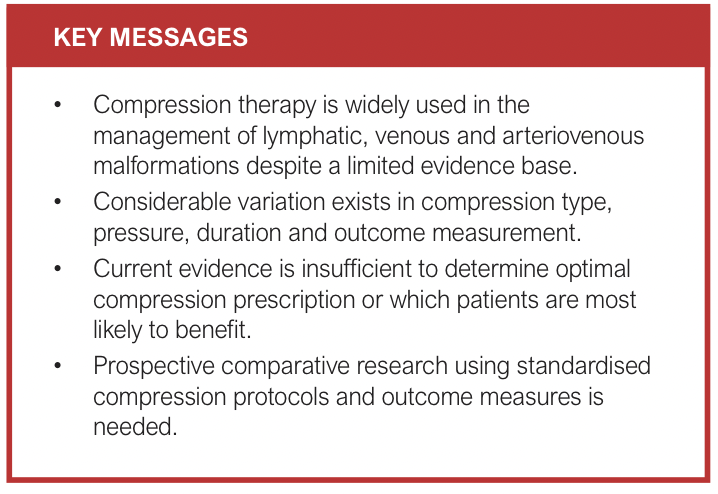
Taken together, the four themes demonstrate that compression therapy is widely incorporated into the management of vascular malformations despite a heterogenous and methodologically limited evidence base. There remains a need for larger prospective comparative studies using standardised compression protocols and agreed outcome measures to better establish its effectiveness across different vascular malformation subtypes and patient groups.
Strengths and weaknesses
This scoping review provides an updated mapping of the evidence relating to compression therapy for vascular malformations, including its use as a standalone intervention and alongside multimodal management. The review identifies important variation in compression prescription and outcome measurement, highlighting priorities for future research. However, the conclusions that can be drawn from this review are limited by a small and heterogeneous evidence base dominated by observational studies, case reports and case series. Frequent use of co-interventions, together with variation in vascular malformation subtype, compression prescription, follow-up duration and outcome measurement, further restricted comparison between studies.
Conclusion
This review identified a limited but evolving evidence base for compression therapy in vascular malformations. Although evidence suggests potential benefits for lesion size, limb circumference, symptoms and other clinical outcomes, substantial variation in compression prescription, outcome measurement and study methodology limits confidence in determining its effectiveness. Current evidence remains insufficient to determine the optimal type, pressure and duration of compression therapy or identify which vascular malformation subtypes are most likely to benefit. Future prospective comparative studies using standardised compression protocols, objective and patient-reported outcomes and adequate follow-up are needed to strengthen the evidence base and inform clinical practice. A stronger evidence base can also facilitate the development of consensus-based guidance for the use of compression in vascular malformations.
Article DOI:
Journal Reference:
J.Vasc.Soc.G.B.Irel. 2026;Online ahead of publication
Publication date:
November 20, 2026
Author Affiliations:
Lymphoedema Wales Clinical Network, Swansea Bay University Health Board, Neath, UK
Corresponding author:
Dr Daniel Rothwell
Lymphoedema Wales Clinical Network, Swansea Bay
University Health Board,
Cimla Health & Social Care Centre, Cimla, Neath
SA11 3SU, UK
Email: Daniel.Rothwell@ wales.nhs.uk