ORIGINAL RESEARCH
Current practice in consenting patients for superficial venous intervention
Howitt A,1 Mohamed A,1 Hitchman L,1 Sciberras P,1 Long J,1 Pymer S,1 Smith G,1 Chetter I,1 Garnham A,2 Carradice D1
Plain English Summary
Why we undertook the work: Varicose veins are very common and affect nearly 40% of the UK population, both men and women equally. They can become symptomatic resulting in aching, itching or swelling of the affected leg. Complications of varicose veins include bleeding, phlebitis (painful inflammation of a vein) and leg ulcers. There is strong evidence to show that people who suffer from symptoms from varicose veins, or get a complication related to varicose veins, have a poorer quality of life. Options to treat varicose veins are offered on the NHS, which include a type of keyhole surgery that burns the vein from the inside causing the problem vein to close. Other treatments include an injection of a foam or another technique where the surgeon makes small cuts to pull out the troublesome veins. They are usually done as a day case procedure under local anaesthetic, meaning recovery time is quick and often people are back to work or daily activities within a few days. As with any surgical procedure, there can sometimes be complications. Before deciding to have an operation to treat varicose veins, the surgeon or clinician should discuss the procedure, benefits and what complications could happen. This is called the consent process. Without a proper consent process the patient would not have all the correct information to make the right decision for themselves, it can increase anxiety and confusion for the patient, and it can also risk a lawsuit for the surgeon. Sometimes people might get a complication from the procedure and, if they were not informed enough beforehand, they may end up regretting the surgery because they did not have all the right information to enable them to weigh up the options. Traditionally, the consent process set up is a discussion between surgeon and patient on the day of the procedure, a form is signed by the patient and then the surgery can go ahead. However, currently there is not much research investigating what surgeons do or say in the consent process. The purpose of this project is to find out what surgeons say to their patients before offering surgery for varicose veins and how they give information to their patients. It also aims to capture what a surgeon’s own understanding is of how common or uncommon each complication may be in practice.
What we did: We sent out an online survey to vascular surgeons across the UK. This included surgeons in training, of various levels, and consultants who performed varicose vein procedures. The survey collected information on what complications are discussed and how often, as well as those not discussed. It also gathered information on how surgeons classify different complications according to how common or uncommon they think the complication is. It also collected data on how a surgeon gives the patient information on the procedure.
What we found: One hundred and thirty surgeons completed the survey. Most of the respondents were consultants (113/130; 87%) and the rest were surgeons in training. The spread of responses covered the entire UK including Scotland, Wales, Northern Ireland and all regions within England. There were 34 complications in total that surgeons said they would discuss with patients. However, only three of these 34 complications were routinely mentioned by the majority of surgeons (which we defined as 70%). These were venous thromboembolism, recurrence (the veins coming back later) or sensory disturbance (numbness or tingling of the skin in the area treated). The overall result has shown a large variation in how surgeons’ consent, what they tell patients and the ways that they tell patients.
What this means: There are large differences in how risks are discussed with patients. This means patients may currently receive inconsistent information about the risks of varicose vein procedures, which can affect understanding and their decision-making. It highlights for clinicians that there needs to be clearer guidance and better research to support consistent evidence-based consent discussions. For the NHS, it supports developing a national framework for consent which could help reduce patient complaints, improve patient experience and lower the number of legal claims related to poor consent for varicose vein surgery.
Abstract
Background: The consent process is a core element and legal prerequisite to surgical practice globally. Failure of the consent process is a frequently and increasingly cited cause of dissatisfaction and successful litigation claims within NHS surgical practice, and superficial venous treatments are disproportionately represented within vascular surgery. The aim of this study is to capture clinician practice in consenting for superficial venous intervention.
Methods: An online survey was devised and piloted in a tertiary vascular unit prior to national distribution to clinicians through professional platforms and networks including members of the Vascular Society of Great Britain and Ireland. The threshold for consensus of inclusion of complications was defined at 70% in accordance with published Delphi studies.
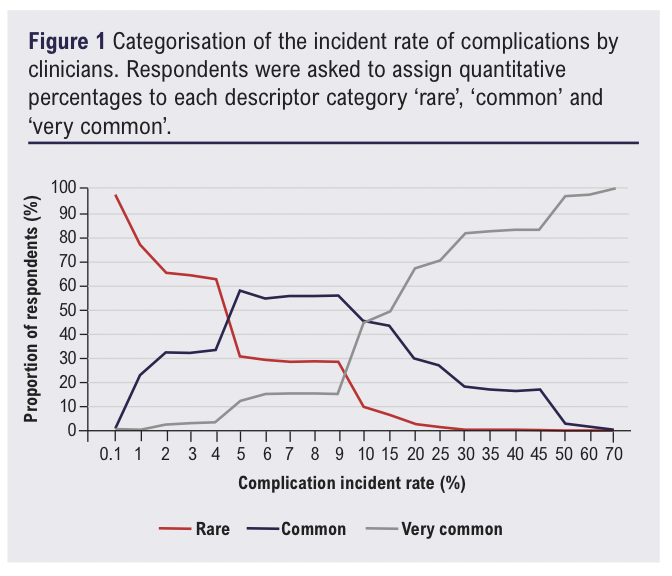
Results: There were 130 respondents (87% of whom were consultants) across all regions of the UK. Thirty-four distinct complications were listed as routinely quoted during consent. Only 29% of respondents use pre-printed/pre-prepared consent forms, but 64% agree that they would be of benefit. The median number of complications quoted by respondents was 7 (range 3–34). Only three reached consensus, with 97% routinely quoting venous thromboembolism, 78% recurrence and 78% sensory disturbance. 84% of respondents gave an indication of the frequency of complications, but there was significant variation in quoted frequencies. Summary descriptions of frequency are unlikely to be a reasonable replacement for percentages as there was considerable disagreement over categorisation. For example, a complication rate of 9% was categorised as ‘rare’ by 29%, ‘common’ by 56% and ‘very common’ by 15% of respondents.
Conclusion: There is significant variation in the mode, method and delivery of the consent process nationally. Work is urgently needed to improve the overall quality of this process and ensure a standardised national approach.
Introduction
The consent process for any surgical intervention is a fundamental part of medical and surgical practice worldwide. Increasing quality and availability of information, support tools and greater patient expectations for engagement in treatment decisions and autonomy over their care has shifted the paternalistic role of the clinician to a supportive and collaborative one, with a shared decision-making approach between patient and clinician at its heart.1,2 This has been echoed through the creation of NHS England’s shared decision-making models and initiatives such as ‘NHS Choices’.2
Aside from supporting shared decision-making, valid consent is a legal prerequisite to any surgical procedure performed. This is implemented in UK law through legislation, and high-profile cases such as Montgomery versus Lanarkshire (2015) have set out further legal precedents which may be ethically reasonable but practically challenging to employ.3 Guidance for the main ethical and professional principles of the consent process in the UK is set out by the General Medical Council (GMC) and further recommendations issued by professional bodies such as the Royal College of Surgeons (RCS).4,5 These frameworks are purposefully broad and therefore do not provide detailed procedure-specific guidance including contemporary risks for routine discussion, strategies for communicating complication rates or presentation of information to patients, leaving scope for variation in specific consent practice.
According to Hospital Episode Statistics (HES) data, 30,000 superficial venous procedures are delivered annually by the NHS in England with a similar number estimated to be delivered in the private sector. These treatments are known to be safe and effective, with a low risk of complications, a rapid recovery and very high rates of patient satisfaction.6-8 Despite this, varicose vein procedures historically account for the largest individual contribution towards successful legal claims (48%) within vascular surgical practice in the NHS.9.10 Flaws in the consent process are significantly and increasingly contributing factors towards successful litigation claims across all surgical specialties, with an increase from 128 to 248 claims per year in 2011–2012 and 2021–2022.11
The purpose of this observational survey is to establish current consent practice and variation in consenting for superficial venous intervention across UK vascular units, whilst establishing agreed complications clinicians prioritise in routine discussion. Exploring variation in practice will identify areas for improvement, inform the development of more streamlined standardised consent processes and support consistency in the provision of patient information relating to superficial venous procedures across the UK.
Methods
Questionnaire development
A 10-part online pilot survey was devised by members of the venous special interest group. The content was reviewed and refined by two consultant vascular surgeons with established expertise in venous research, a vascular surgery registrar and an academic research manager with qualitative methodology expertise. The survey included a combination of free-text, binary and multiple-choice items to ensure the breadth and nuance of perspectives were captured. The survey was piloted to assess content and face validity within a single tertiary vascular unit amongst 10 consultants and eight registrar level doctors in two rounds. Minor alterations to question phrasing were made by three reviewers who devised the survey based on the pilot group feedback to improve readability and clarity of wording. Amendments were re-tested to the same pilot group with no further changes, producing the final questionnaire (see Appendix 1 online at www.jvsgbi.com). Items purposefully used the umbrella term endovenous ablation to encompass all minimally invasive techniques including endothermal ablation (radiofrequency ablation and LASER), foam sclerotherapy, mechanochemical ablation, cyanoacrylate closure and phlebectomy. Open surgical techniques including high tie and ligation and stripping were not included as risk profiles significantly differ. In the context of this paper, superficial venous interventions are used interchangeably with endovenous ablation due to the exclusion of open techniques in the survey. The target population were UK-based vascular surgeons who carry out superficial venous interventions both in the NHS and private sector. This encompassed all training levels from ST3+ to consultant (or equivalent). We defined ‘clinicians’ as ‘doctors’ to reduce heterogeneity in respondent backgrounds, training and professional responsibility. Whilst acknowledging this excludes colleagues with nursing backgrounds and other allied healthcare professionals who hold critical roles in the multidisciplinary care of patients, in most surgical settings the surgeon holds primary legal and professional responsibility for the consent process and whose perspectives are directly relevant to the study.
Questionnaire dissemination
The final survey was distributed to trainee and consultant vascular surgeons nationally using the Qualtrics XM platform. Dissemination was through the Vascular Society Annual Vascular Meeting, Vascular and Endovascular Research Network (VERN), Vascular Society (VSGBI) and Vascular Research UK with links promoted on social media platforms. Responses remained anonymous, allowing clinicians to report routine practice confidentially and reduce social desirability bias. Due to dissemination via open online platforms, the total number who viewed the survey was unknown so the true response rate could not be calculated.
Using a free-text box, respondents listed the complications routinely discussed with their patients undergoing superficial venous intervention. To minimise recall bias, once completed respondents were unable to revisit this section to reduce the possibility of later survey content influencing responses and preventing retrospective changes to answers once respondents were exposed to a complication list. During consent clinicians often quote information around the incident rates of complications, which may be presented numerically as a percentage or qualitatively using descriptive terms to demonstrate the likelihood of occurrence. To explore this practice, the questionnaire asked respondents to allocate descriptors (‘rare’, ‘common’ or ‘very common’) to individual complications identified by the study authors based on their perceived incidence.
The survey also aimed to understand how clinicians relate these descriptive terms to quantitative risk, asking respondents to assign percentage incidence rates to each descriptor above. The final part of the survey gathered broader information on individuals’ contemporary practice including the use of incorporated adjuncts (such as pictures, written advice, videos) and views on the value of pre-populated consent forms.
Data were entered into a bespoke spreadsheet and analysed using Microsoft® Excel® (Microsoft, Redmond, WA, USA). Responses not containing any completed survey questions were excluded from analysis. Partially completed survey responses were included for fully answered questions to maximise data capture. Clinicians’ free-text responses were used to map the assigned percentage incidence rates associated with the descriptors ‘rare’, ‘common’ or ‘very common’ onto a graph to visualise the distribution of responses.
The agreement thresholds were defined prior to data collection as 70% for inclusion and <30% for exclusion. A complication was considered to achieve agreement for inclusion if it was independently reported by at least 70% of respondents. This is in keeping with commonly set consensus thresholds used in Delphi and RAND studies.12
Results
The survey had 130 respondents with a completion rate of 96% (130/136). Amongst respondents, 13% (17/130) were trainees and 87% (113/130) were consultants. The data included 52% (68/130) of clinicians who performed more than 80 varicose vein interventions annually and 48% (62/130) of clinicians performing fewer than 80 cases annually. The spread of responses covered the entire UK including Scotland, Wales, Northern Ireland and all regions within England.
Thirty-four distinct complications were listed by respondents as routinely quoted during consent (Table 1). The median number of complications quoted by respondents was 7 (range 3–34). There were no differences between trainees or consultants in the number of complications quoted.

On review of these complications, only three reached the agreement threshold for routine inclusion. The complication that reached the highest agreement threshold at 97% (126/130) was venous thromboembolism. 78% (101/130) of respondents quoted recurrence and 78% (102/130) sensory disturbance. 68% (23/34) of complications listed by clinicians met consensus for exclusion (these are listed in Table 1). Of these, 56% (19/34) were listed by less than 10% of respondents.
When communicating complications to patients, 16% (21/129) of respondents do not give any indication of the frequency of complications and, of the 83% (107/129) who do, there is significant variation in how this information is presented. 48% (62/129) quote the risk of complications as a percentage, 18% (23/129) would use the incidence per 100 or per 1000 cases and <1% (5/129) use pictorial representations. 20% (27/129) of respondents use a combination of these. Other approaches included broad descriptor summaries (adopted by four respondents) and patient information leaflets (quoted by three respondents).
There was wide variation in the incidence rates which clinicians assigned to each descriptor (Figure 1). For example, for a complication incidence rate of 5%, 10% of respondents would describe that as ‘very common’, nearly 50% would describe it as ‘common’ and 40% would describe it as ‘rare’. The only consensus seen was that >70% of respondents would describe a complication with an incidence of less than 1.5% as ‘rare’ and a complication with an incidence rate above 25% as ‘very common’. There was no agreed incidence rate range for the descriptor of ‘common’. A sensitivity analysis was performed to look separately at the seniority of the respondent and the case load of the respondent, and no difference was found between these.
Thirty-six of the 129 respondents (28%) use pre-prepared consent forms, but 64% (83/129) agree that they would be of benefit. Benefits described included standardisation of information given to all patients, thus helping communicate the risks of superficial venous intervention and serve as a prompt to minimise exclusion of information. It was emphasised that standardised forms could save consultation time and therefore improve depth of discussion. Those who disagreed stated that individual nuanced discussions with patients were of higher benefit and highlighted that standardised consent forms exclude personalised risk assessment or patient-specific factors. It was argued that the discussion is more important than the documentation and a pre-printed consent form may not reflect the depth of the actual consultation. Others felt that clinic letters were more crucial in the consent process. Some were concerned that pre-populated consent forms would inevitably encompass all possible complications as opposed to the most relevant patient- or procedure-specific ones. A key theme throughout was that a pre-prepared consent form has numerous benefits but, alone, it will not solely improve the consent process.
Discussion
The key purpose of this study is to provide contemporary observational data on the perceptions and practice of consenting for venous procedures from a clinician’s perspective. This national survey observes significant variability in how UK vascular surgeons approach the consent process and demonstrates that there is little agreement on which complications should be routinely discussed, frequency of occurrence or continuity in communication of risk to patients. Heterogeneity was seen in the clinicians’ interpretation of frequency descriptors, which could impact patient understanding and threaten the robustness of the consent process. Twenty-one of the 129 respondents (16%) did not explicitly indicate risk frequency at all and, in those who did, a range of methods was used. Some clinicians categorised risk using descriptors such as ‘rare’, ‘common’ or ‘very common’. Whilst these are widely adopted in clinical practice, the results challenge the reliability and consistency as tools for risk communication. On this basis, qualitative descriptive terms should not be used in isolation but, rather, should be supported by quantitative data and patient-tested education materials to provide context and aid interpretation. Inconsistencies in terminology may create additional barriers for patients with lower health literacy who may have challenges interpreting risk in numerical or qualitative formats. A study of patient encounters reported that one-fifth of health professionals had at least one daily encounter with patients who struggled with comprehension and application of health information. For patients to actively engage in meaningful consent, the appropriate method of communicating must align with the health literacy level.13-15
Numerical presentation such as percentages or frequencies per 100 cases was another commonly reported method of conveying risk. Although these approaches remove ambiguity associated with qualitative descriptions, their accuracy depends on underlying clinical evidence, with reliance upon quality of the data and the familiarity of the clinician to the data. Both of these can be variable, and neither were examined in this study. In addition, clinicians expressed a desire to personalise risk; however, there are limited data to support this process at present. Best evidence is dynamic and changes with emergence of new data; for example, a recent publication has called into question what the current best evidence suggests regarding the incidence of venous thromboembolism following treatment.16 Incidence rates may be higher than conventionally considered previously by a factor of 10. Not only should the clinical community be kept informed of developing changes in data patterns, but information packages supporting decision-making and consent resources need to be responsive as well. The increased use of personalised care will accompany improving data and may further complicate or simplify the consent process. Unfortunately, superficial venous interventions are excluded from existing vascular registries, despite being the most frequently performed procedures within vascular surgery. This limits the synthesis and dissemination of high-quality contemporary data on complications and represents a key evidence gap. Addressing this would support more accurate risk communication and a more consistent approach to consent across the specialty.
Meaningful and valid consent of course extends beyond the communication of risk, although this is usually a critical element in retrospective dispute. In addition to frameworks set out by the RCS and GMC, guidance on medical consent is provided in the Department of Health reference guide to consent for treatment.17 These establish the underlying principles; however, practical guidance on procedure-specific risks or communication strategies conveying risks are not offered. The findings of this study highlight the consequences of this gap and, whilst not an assessment of consent quality or clinical outcomes, it was observed that patients receive a varied scope of information depending on the clinician conducting the consent, which could contribute to uncertainty around meeting expectations established by the Montgomery ruling.18 Shared decision-making relies on accurate and consistent communication of risk. If clinicians disagree on which complications to discuss or the likelihood of occurrence, patients may find challenges in making informed choices about the care they receive and could contribute to dissatisfaction.
A lack of unanimity on any one complication to discuss with patients suggests that clinicians’ prioritisation of procedural risks vary. Venous thromboembolism was among the few complications to reach the agreement threshold, likely reflecting the potential for morbidity and mortality from an intervention intending to improve quality of life. Clinicians placed greater emphasis on complications with severe clinical consequences rather than more common but less serious outcomes such as bruising or pain. There was an under-emphasis of perceived ‘minor’ complications, but these could have significant importance for patients if impacting recovery time, return to work or care duties and overall experience. Most quoted complications reached less than 10% agreement for inclusion in the consent process. If so few of the expert clinicians agree to routine discussion with patients, this poses the question of whether they should be quoted routinely and reserved for individualised discussions based on risk factors, preferences, information needs and circumstances. Determining this balance, as highlighted in the Montgomery case, remains a challenge in clinical practice and requires the patient perspective, which was not assessed during this study and must be addressed in future research priorities.
Previous studies have sought to address the issue of informed consent for superficial venous procedures. The DISCOVAR study group reached consensus through a Delphi process on 12 major and 12 minor complications that should be included for consent discussions, but the study methods did not explore how these are implemented in practice.19 They also quoted the Royal Dutch Medical Association (KNMG) guidance that complications occurring in >1% of patients must be discussed. This threshold varies from UK case law, where potentially any complication, however rare, may be required to protect against litigation. Another study sought to outline essential information that should be shared with patients including benefits and alternative treatments.20 None of these studies examine how consent is delivered in routine clinical practice or how clinicians interpret and communicate information to patients.
Contemporary NHS Resolution data show approximately 130 vascular surgery claims annually in England, with around £205 million paid on successful claims between 2014/15 and 2023/24.21 As discussed previously, historical evidence suggests varicose vein surgery accounted for almost half of successful vascular claims, but modern NHS Resolution data do not provide a procedure-specific breakdown so there remains uncertainty regarding the current contribution.9 This sustained rise in litigation claims relating to consent highlights the importance of effective communication and robust consent practices in the modern healthcare climate. A misalignment of patients’ expectations compared with actual outcomes and misunderstanding of procedural risk may contribute to dissatisfaction and, in turn, complaints or medicolegal challenges. The increase in claims across all specialties (with the primary cause of Failure to Warn – Informed Consent) has amounted to a cost of around £80,000,000 between 2021 and 2022, the highest in a one-year period to date.11 In a resource-constrained NHS, reducing litigation costs due to deficiencies in the consent process is a compelling priority. However, while greater standardisation of components of the consent process may improve the consistency and quality of information provided to patients, such an approach should complement (rather than replace) individualised patient-centred discussions that reflect their values and preferences.
Study limitations
The limitations of this study include a selection bias, as data were collected using a voluntary response strategy so clinicians with a particular interest in venous disease may have been more likely to participate. As with many contemporary surveys, due to open dissemination of the survey through professional platforms online a response rate could not be calculated. There are potential reporting biases, as some clinicians may have over-reported the complications quoted in their routine practice or conversely under-reported them. Independent anonymous online completion aimed to reduce social desirability bias; however, the survey relied on self-reported practice rather than objective auditing of actual practice. The agreed threshold for consensus was set at 70% a priori (in line with thresholds commonly used in Delphi methodology), and whilst this varies within the literature, only four outcomes in this study reached >50% agreement so the principal findings are unlikely to be affected. The patient perspective was not assessed in this study so findings do not reflect patient needs or expectations. It is established that vascular patients prefer a shared decision-making process with their surgeon, therefore future research priorities should explore patient expectations of the consent process through qualitative interviews and focus groups alongside involvement of key medicolegal stakeholders.22
Article DOI:
Journal Reference:
J.Vasc.Soc.G.B.Irel. 2026;5(4):170-176
Publication date:
August 28, 2026
Author Affiliations:
1. Academic Vascular Unit, Hull University Teaching Hospitals NHS Trust, Hull, UK
2. Department of Surgery, The Royal Wolverhampton NHS Trust, Wolverhampton, UK
Corresponding author:
Miss Annabel Howitt Academic Vascular Unit, Hull University Teaching Hospitals NHS Trust, Hull, HU3 2JZ, UK
Email: [email protected]