
PROTOCOL
Decisional regret in vascular surgery: a scoping review protocol
Stanley S,1,2 Soyemi O,3 Stewart H,2 Shelton C2,4
Plain English Summary
Why we are undertaking this research: ‘Decisional regret’ is a negative emotion associated with a decision, its outcome or how it was made. Decisions about vascular surgery can feel rushed, frightening or confusing. Some patients regret the decision to have vascular surgery. Understanding why some patients regret surgery is important. It can help clinicians develop ways to support future patients in making decisions about surgery. We aim to design a future study to investigate regret after vascular surgery. To do this we need to understand what research has already been done on this topic. We also need to understand if this research topic is important to patients.
What we aim to do: The aim of this study is to do a more detailed search for research about regret after vascular surgery. We will do a broad search of a large number of articles from two online medical libraries. After we filter and exclude irrelevant results, we will read and summarise the findings of the relevant articles. We will present these findings to patients with experience of vascular surgery and work together to describe what research already exists. Patients can identify gaps that are important to study further that researchers may miss. We will describe areas where research is missing. For example, decisional regret may have been investigated after some operations more than others. We will decide which aspects of regret we should research further and how best to do this. Ideas from patients and the research will be combined to design a future study about regret after vascular surgery. A future study could help make conversations before surgery better and more supportive. Work from this project will ensure that this future study is both necessary and important to patients.
Abstract
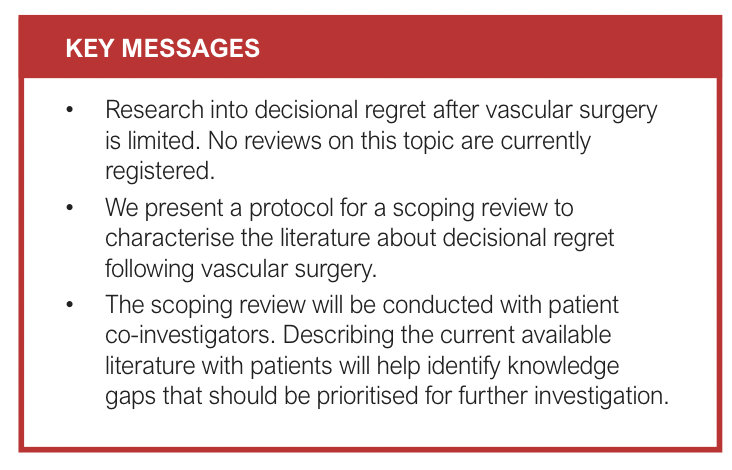
Background: Decisional regret describes negative emotions relating to a decision. Some patients regret the decision to have surgery, causing emotional distress and mistrust of healthcare providers. Understanding decisional regret could improve communication and help clinicians support future patients in making decisions about surgery. Vascular surgery can have significant complications, yet research into decisional regret after vascular surgery is limited. No reviews on this topic are currently registered.
Methods: In this report we present a protocol for a scoping review to characterise the literature about decisional regret in patients following vascular surgery. It will be conducted with reference to the Joanna Briggs Institute guidelines. Two academic databases (MEDLINE and CINAHL) will be searched for terms relating to “decisional regret” and “vascular surgery”. A specialist librarian will develop the database searches. Additional literature and citation searches will be conducted using Google Scholar. The results will be screened against predefined inclusion criteria. Data will be extracted to produce a descriptive summary. The summary will be shared with patient co-investigators whose interpretations will inform the review conclusions.
Discussion: Describing the current available literature about decisional regret in vascular surgery will help identify knowledge gaps that should be prioritised for further investigation. An accessible infographic of the review findings will be produced to support future patient and public involvement work.
Introduction
Decisional regret describes significant negative emotions such as distress or remorse following a decision.1 Some patients may regret decisions made about their treatments including whether to have surgery. A decision may be regretted because of the option chosen, the outcome or how it was made. A decision with a ‘good’ outcome may still be regretted if the process is perceived as rushed or pressured. Decisional regret can result in negative experiences of healthcare systems and poor patient satisfaction.2 Developing and implementing interventions that minimise the incidence of decisional regret is a priority for perioperative patients and researchers.3 Communication, patient understanding and shared decision-making have been identified as research priorities for vascular surgery.4 Understanding decisional regret in vascular surgery may contribute towards addressing these.
Previous research has measured decisional regret after surgery using a variety of tools. Some studies asked patients directly about regret following surgery using open-ended or yes/no type questions. Other studies evaluated regret using surveys involving the Decision Regret Scale and/or other Likert-type questions.1 Decisional regret may differ between surgical contexts.3 It has been investigated in some surgical contexts more than others; for example, prostate and breast cancer surgery appear to have attracted more attention from researchers than vascular surgery, despite vascular surgery carrying a relatively high risk of complications.1
A preliminary search for relevant literature about decisional regret in vascular surgery was conducted by a team of clinicians, academics and a specialist librarian with literature review experience. We searched PubMed and Google Scholar in September 2025 using terms including “decision* regret” and “vascular surg*”. Approximately 10 relevant studies were retrieved. These included one survey from the USA of 572 patients which estimated the prevalence of decisional regret following four common vascular surgery procedures as 14.2%.5 This was related to procedure type, being more common among patients undergoing lower extremity procedures (amputation or revascularisation) than other vascular procedures.5 A 2017 systematic review of 79 studies about decisional regret in surgery included only one study involving patients who underwent vascular surgery.1,6 Of the 54 patients who underwent great saphenous vein surgery in this study, two (4%) regretted the procedure at 12 months.6
The limited available research suggests that some patients may experience decisional regret following vascular surgery. However, the prevalence of decisional regret following certain vascular procedures is not fully understood. Patient-, procedure- or decision-related risk factors for experiencing regret after vascular surgery have not been identified and understanding why patients regret certain operations has not been explored. No reviews on this topic are currently registered on PROSPERO or the Joanna Briggs Institute websites.7,8
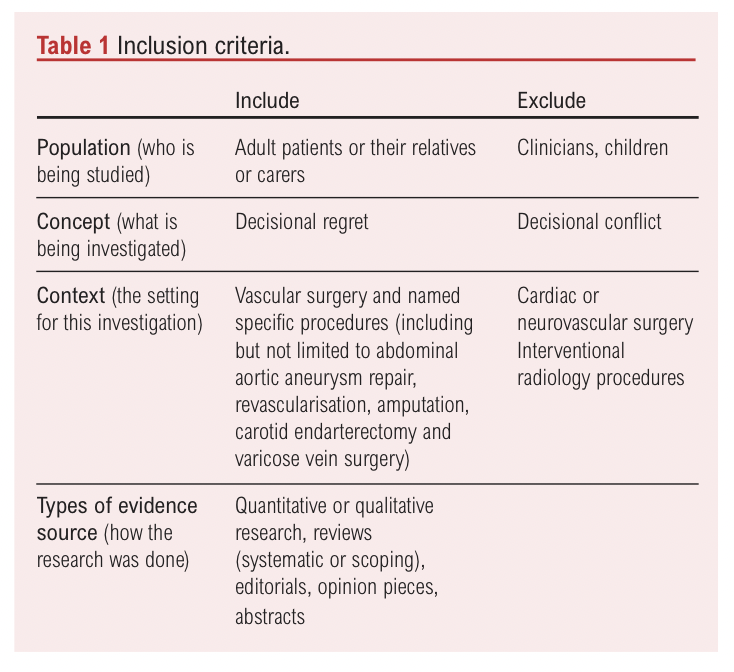
This scoping review will characterise the existing research about decisional regret in patients following vascular surgery. Specifically, it will describe how decisional regret has been evaluated and the surgical contexts in which it has been studied. It aims to identify gaps in the literature and inform potential areas for future research.
Patient and public involvement
We undertook a patient and public involvement activity to explore whether patients valued decisional regret as a research topic and whether the proposed role for patient co-researchers was acceptable. A presentation of the research topic and proposed study was delivered to a group of eight patients organised through Vocal (an organisation hosted by Manchester University NHS Foundation Trust in partnership with The University of Manchester). Discussions about the research topic were positive. Patients described the topic as under-researched and not obvious, yet still important. Patients felt it was also important to understand decisional regret amongst family members and caregivers in addition to patients. As a result, the inclusion criteria were expanded to include studies involving the relatives or carers of adult patients. The focus group supported the role of patient researchers and suggested that a brief lay summary of the included studies (plus access to the original abstracts) would support this role. Some members felt it was important to present the findings of the scoping review back to a larger group to gather a wider range of opinions on the research before designing a future study. We have planned to do this.
Methods
This scoping review will be conducted by a team of clinical, academic and patient researchers with reference to the Joanna Briggs Institute methodological guidelines.9
Search strategy
Two online databases (Ovid MEDLINE and CINAHL) will be searched initially. The reference lists of included sources will then be searched manually. Google Scholar will be used to facilitate forward and backward citation searching of relevant articles. Finally, a search will be conducted using Google Scholar to capture additional literature (eg, abstracts and theses).
Database searches will be developed with the support of a specialist librarian (author OS). The population of interest is adult patients who have had vascular surgery. Synonyms for “vascular surgery” and specific procedures (eg, abdominal aortic aneurysm repair, angioplasty, bypass or stenting procedures, lower limb amputation and carotid endarterectomy) will be included in the search terms. The concept of interest is “decisional regret” and synonyms for this term will also be searched. A proposed search strategy for Ovid MEDLINE is provided in Appendix 1 (online at www.jvsgbi.com). Search results will be limited to English language only because this is the only language spoken fluently by the whole review team. Results will not be restricted by geographical location or publication date.
Screening and data extraction
Titles and abstracts will be screened against predefined inclusion criteria (Table 1). The full texts of potentially relevant resources will be subsequently reviewed against the same criteria for inclusion. Primary research (qualitative or quantitative study designs) and review articles (systematic or otherwise) will be eligible for inclusion. Studies involving patients undergoing any vascular surgery procedure will be eligible for inclusion even if studied with other surgical populations. Based on the limited research identified by our preliminary search, the inclusion criteria will be kept intentionally broad. Screening will be performed by one review team member (author SS) using the Rayyan online platform.10 Inclusion decisions will be reviewed by a second reviewer with disagreements resolved by consultation with a third. Data from included sources will be extracted using the Joanna Briggs Institute data extraction form (Appendix 2 (online at www.jvsgbi.com)) with modifications made to ensure relevance to the aims of the scoping review.9 Extracted data will include evidence source details and characteristics (eg, citation details, context, country and participant information) and details or results extracted from the source of evidence specific to the scoping review concept (eg, tool used to measure decisional regret, rate of decisional regret, timing of decisional regret measurement and factors associated with decisional regret). The modified form will be trialled on a sample and amended, if necessary, before being applied to all included sources.
Analysis and presentation of results
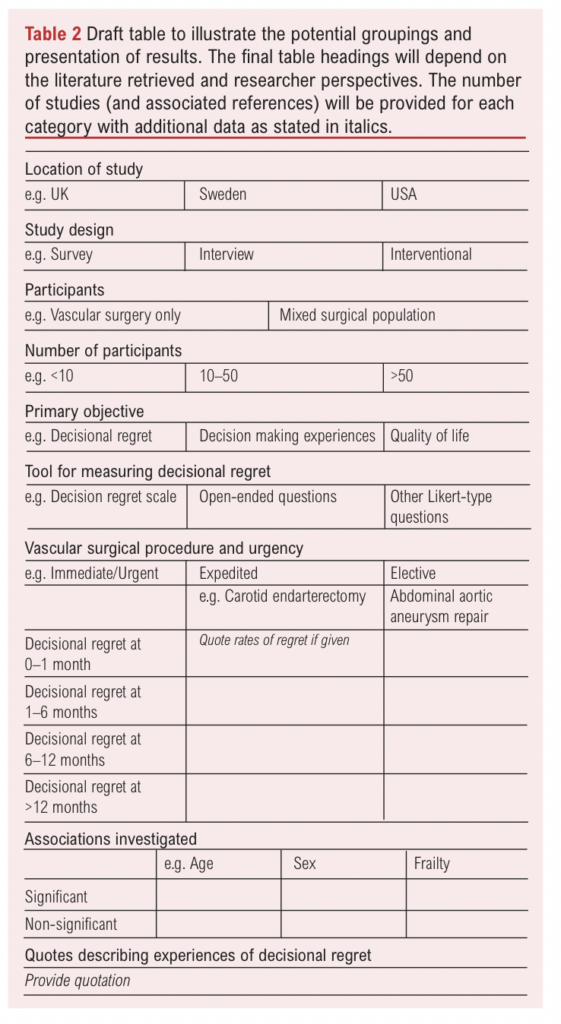
Clinical and patient researchers will analyse the included resources. Capturing the meaning of the research landscape from both perspectives aims to ensure that future research meets the needs of the people it is intended to benefit. Included sources will be collated and a descriptive summary of each will be generated by a clinician researcher. Summaries will be presented to the patient reviewers and their interpretations of the research landscape sought. Interpretations will be recorded as field notes and will inform the final review conclusions. Patient and clinician researchers will work together to group and organise the resources in a way that highlights the key findings within the research landscape. The final groupings will be determined by the available literature and researcher perspectives. Potential groups could describe study characteristics (eg, study design or measurement tools used), clinical context (eg, type of vascular procedure) or features of decisional regret (eg, measured values, associations or impact). The review findings will be presented in a tabular format to highlight potential areas for future research (Table 2). Reports of the scoping review will follow the PRISMA-ScR checklist.11 A lay summary and infographic will be used to present the review findings in an accessible format to support future patient and public involvement work.
Conclusion
This scoping review will identify and characterise gaps in the literature and outline potential areas for future research. It will inform the focus and value of a future study into decisional regret in vascular surgery. Decisional regret is emotionally distressing for patients and their relatives. A future study may contribute towards improving communication and support for patients who are making decisions about vascular surgery. Joint investigation between clinical researchers and patients aims to ensure that any future studies are informed by the people they intend to benefit.
Article DOI:
Journal Reference:
J.Vasc.Soc.G.B.Irel. 2026;5(3):152-155
Publication date:
May 27, 2026
Author Affiliations:
1. Lancaster Medical School, Lancaster University, Lancaster, UK
2. North West School of Anaesthesia, Manchester, UK
3. Blackpool Teaching Hospitals NHS Foundation Trust, Blackpool, UK
4. Department of Anaesthesia, Wythenshawe Hospital, Manchester, UK
Corresponding author:
Dr Sophie Stanley
Lancaster Medical School,
Lancaster University,
Lancaster LA1 4YW, UK
Email: s.a.stanley@ lancaster.ac.uk