
QUALITY IMPROVEMENT PROJECT
Improving vascular referral coordination through live documentation in a hub-and-spoke system
Al-Kassar A, Abdelrahman R, Makar RR
Plain English Summary
Why we undertook the work: Vascular patients are often reviewed in different hospitals within a hub-and-spoke network. This can make it difficult for teams to share information consistently, which may lead to unclear follow-up plans and incomplete documentation. We wanted to improve how referral information and management decisions were recorded and shared across the vascular team.
What we did: We introduced a live shared documentation sheet on a secure cloud platform. Clinicians at both the main vascular centre and spoke hospitals used this sheet to record patient referrals and management outcomes. We compared documentation before and after adding a structured ‘Outcome’ column.
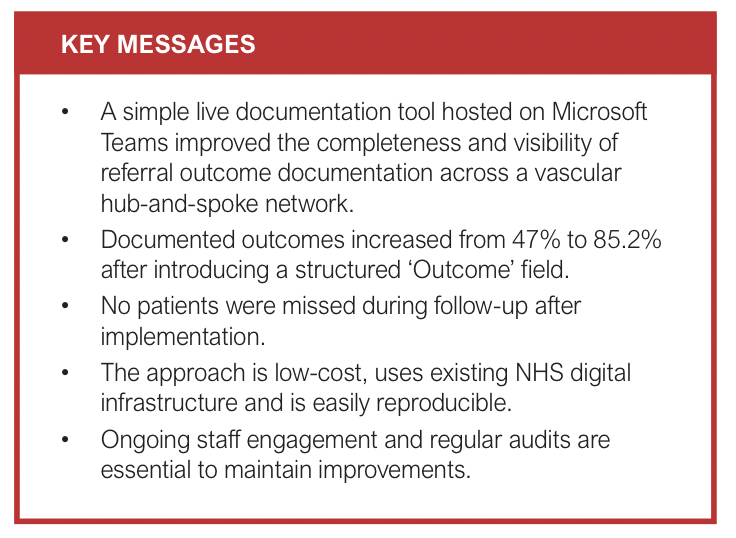
What we found: Before introducing the Outcome column, only 47% of patients had a documented management outcome. After the change this increased to 85.2%, and no patients had missing follow-up documentation.
What this means: A simple secure shared digital tool can improve the completeness and visibility of documented management decisions across hospital sites. Continued staff engagement is important to maintain these improvements over time.
Abstract
Introduction: The centralisation of vascular services within the National Health Service (NHS) has improved outcomes for complex procedures by concentrating expertise within high-volume centres. However, hub-and-spoke models can introduce challenges in maintaining consistent communication and documentation across sites. This study evaluated a live cloud-based documentation system designed to improve the visibility of referral outcomes within a regional vascular network.
Methods: This quality improvement project comprised two retrospective review cycles of vascular referrals recorded on a shared Microsoft Teams-hosted spreadsheet. The first cycle analysed referrals from December 2023 and the second from August 2024. Recorded variables included patient demographics, referral source, urgency category and responsible clinician. In July 2024 a structured ‘Outcome’ field was introduced to document management decisions and follow-up plans. Clinicians were instructed to complete this field immediately following patient review.
Results: In December 2023, 66 referrals were recorded, with outcome documentation present in 47% of cases and one patient (1.5%) lacking follow-up documentation. In August 2024, 88 referrals were reviewed, with 85.2% containing documented outcomes and no patients with missing follow-up information. These findings demonstrate a marked improvement in the completeness of outcome documentation following introduction of the structured outcome field.
Conclusion: Implementation of a live shared documentation system within an existing NHS-approved platform was associated with improved completeness and visibility of recorded management decisions across a centralised vascular network. Ongoing staff engagement and routine review cycles are essential to sustain documentation quality and system adoption.
Introduction
Over the past two decades there has been a clear trend in the UK National Health Service (NHS) towards the centralisation of hospital services. In vascular surgery this model typically consists of a central hub for surgical interventions and multiple spoke sites that provide outpatient follow-up and some minor procedures, such as varicose vein treatments and angioplasties.
Clinicians have identified systemic communication deficiencies that negatively affect referral and review processes. These include lost referrals during inter-site transfers, aligning with the findings of Hakeem and Najem who reported delays in referrals and treatments across a vascular network and emphasised the need for ongoing monitoring to mitigate these inefficiencies.1
Such communication lapses extend beyond referrals. Wariyapola et al highlighted significant deficiencies in discharge communication during patient transfers between hub and spoke centres. They recommended dedicated discharge coordinators as a potential solution to enhance care transitions.2
Centralisation in vascular surgery is supported by robust evidence showing a volume–outcome relationship. High-volume centres, particularly in aortic aneurysm repairs, consistently achieve superior results. Similar patterns are observed in procedures such as carotid endarterectomy and critical limb ischaemia management. These centres benefit from multidisciplinary care and specialised infrastructure, which translates into improved outcomes.3
International data from over 9000 ruptured aneurysm repairs showed a nearly 10% mortality difference between high- and low-volume centres, consistent with earlier UK findings where the gap once reached 24%.4,5
While this structure promotes optimal clinical outcomes, the literature repeatedly highlights communication gaps that impair patient care and cause delays. To address this, we developed a live documentation tool aimed at improving follow-up coordination.
Method
A quality improvement project (QIP) using retrospective review was conducted, including all patients prospectively added to a centralised vascular referral list during December 2023, with a subsequent review in August 2024. The referral system, implemented in October 2023, was hosted on a Microsoft Teams. Access was approved by the hospital Information Technology department and granted to relevant staff across both hub and spoke sites, including vascular clinicians, administrative personnel and the hospital bed management team. Microsoft Office 365 for the NHS provides secure cloud-based applications within NHS governance frameworks, facilitating multidisciplinary collaboration and data sharing.
The referral list was structured as a Microsoft Excel spreadsheet designed to capture comprehensive patient information. Recorded fields included hospital number, NHS number, patient name, date of birth, contact details, referring clinician, spoke site, on-call consultant of the week, presenting symptoms, urgency category, referral location (emergency department, inpatient ward or outpatient clinic) and a general notes section.
Vascular clinicians were instructed to record all referrals requiring urgent vascular review or potential admission, based on referring clinician assessment in line with local practice. Patients admitted as emergencies directly via emergency departments or requiring immediate inter-hospital transfer were excluded as these cases were communicated directly to the on-call vascular team. Elective admissions were managed through a separate scheduling pathway.
Within the vascular network, hub-and-spoke sites operate on different electronic documentation systems. The referral spreadsheet was operationally maintained by the administrative team, who reviewed entries daily to support bed management and patient tracking at the hub site. However, outcomes from clinical reviews conducted at the hub were not consistently visible to spoke teams, resulting in potential communication gaps. This limitation was highlighted during a consultant governance meeting.
To address this, the referral list was modified in July 2024. A structured ‘Outcome’ column was introduced to enable reviewing clinicians to document management decisions and follow-up plans in real time, with the aim of improving transparency and continuity of information across the network.
Results
In December 2023 a total of 66 patients were referred by vascular clinicians to the hub for urgent assessment or potential vascular admission. Although the shared referral list supported referral tracking, documented outcome plans were present in only 47% of cases within the general notes section, and one patient (1.5%) had incomplete follow-up documentation. All other segments in the spreadsheet were completed.
In response to these findings, a structured ‘Outcome’ column was introduced in July 2024 and clinicians were instructed to document management decisions and follow-up plans immediately after patient review.
A subsequent audit conducted in August 2024 evaluated 88 urgent referrals. Outcome documentation improved, with 75 of 88 cases (85.2%) containing completed outcome entries and no patients had missing follow-up documentation. No urgent referrals were excluded or misclassified in either audit cycle. These findings demonstrate a marked improvement in the completeness and visibility of documented management decisions across the network.
Discussion
Vascular surgery has evolved rapidly over the past two decades, with increasing adoption of collaborative and technology-supported models of care. Multidisciplinary team (MDT) meetings involving vascular surgeons and interventional radiologists are now central to clinical decision-making. During the COVID-19 pandemic, these meetings transitioned to online platforms such as Microsoft Teams and have since become embedded in routine practice.6
Vascular patients frequently require long-term follow-up following intervention. Local follow-up within spoke hospitals improves accessibility and patient convenience. However, as Mungall highlighted,7 centralisation can inadvertently reduce access for rural populations despite its clinical benefits. From a clinician perspective, the hub-and-spoke model supports remote assessment and surgical planning but depends heavily on reliable information exchange.
Communication delays remain a recognised limitation of centralised vascular networks. Hakeem and Najem reported increasing referral delays from spoke sites and emphasised the importance of MDT involvement at peripheral centres to improve consistency of care.1 These findings reinforce the need for practical low-cost solutions that enhance visibility of patient management decisions across sites.
Our model addresses these challenges by using an existing NHS-approved platform (Microsoft Teams) to host a shared cloud-based Excel dataset accessible to all vascular team members across the three hospitals within our network. Unlike bespoke electronic referral systems, which often require additional licensing or development costs, this approach leverages existing digital infrastructure. Similar studies have shown that electronic referral and documentation systems can reduce operational costs compared with traditional or custom-built platforms.8
Importantly, our system functions as a shared live dataset rather than a formal e-referral platform. It enables real-time documentation of management decisions and follow-up plans, improving the visibility of clinical information for both hub and spoke teams including situations where patient circumstances change such as non-attendance or clinic review.
Although the second QIP cycle demonstrated substantial improvement in outcome documentation, a small proportion of entries remained incomplete. This is consistent with previously reported challenges during the early adoption of digital systems and highlights the importance of ongoing staff engagement and reinforcement.9 Targeted education informed by audit feedback has been shown to improve compliance and data completeness, and our experience supports this approach.10
The use of a shared electronic system also reduces reliance on paper-based communication, which is known to be vulnerable to loss and unauthorised access. Multiple NHS reports have identified paper records as a frequent source of data breaches. In contrast, the present system operates within a secure access-restricted environment, allowing only authorised vascular team members to enter or modify patient information.11
While this study represents a single-network pilot evaluation with a modest sample size, the simplicity, low cost and ease of implementation make the model readily transferable to other NHS vascular and surgical networks.
Conclusion
The centralisation of vascular services has been associated with improved clinical outcomes through the concentration of expertise and resources within specialised centres. However, this model also introduces challenges in maintaining consistent communication across hub-and-spoke networks. Our evaluation demonstrates that a live cloud-based documentation system provides a practical and cost-effective method for improving the visibility of patient management decisions across sites. The introduction of a structured outcome field was associated with a substantial improvement in the completeness of outcome documentation. Although missed follow-ups were uncommon in both QIP cycles, the intervention enhanced data completeness and transparency within the referral process.
Initial implementation required staff reinforcement and training; however, subsequent QIP findings suggest that sustained engagement and integration into routine clinical workflows can support long-term adoption. Ongoing education, regular audit cycles and leadership endorsement will remain essential to maintain documentation quality. Overall, this study indicates that simple digital solutions, when implemented within existing NHS-approved platforms, can support more reliable information sharing within centralised vascular networks without the need for additional bespoke systems.
Article DOI:
Journal Reference:
J.Vasc.Soc.G.B.Irel. 2026;5(2):90-93
Publication date:
February 27, 2026
Author Affiliations:
Department of Vascular Surgery,
Countess of Chester Hospital,
the South Mersey Arterial Unit,
UK
Corresponding author:
Mr Anwar Al-Kassar Department of Vascular Surgery, Countess of Chester Hospital, Liverpool Road, Chester
CH2 1UL, UK
Email: anwar_kassar@ yahoo.com