EDITORIALS
Making mentorship meaningful: a closer look at the mentoring journey
Long J,1 Haddock-Millar J,2 Popplewell M,3,4 Egun A5
Introduction
Previous editorials set out the rationale for introducing mentorship within UK vascular surgery and provided a high-level overview of what to expect from the VSGBI mentorship programme.1,2 As the first cohort begins its mentoring journey, this issue turns its attention to the mentoring relationship itself: how it develops, what sustains it and how it delivers meaningful professional growth.
Some of you will have heard Professor David Clutterbuck, keynote speaker at the recent VSGBI Annual Meeting in Hull, deliver a thought-provoking presentation on developmental mentoring. He describes mentoring relationships as evolving through five phases: (1) rapport building; (2) direction setting; (3) progress making; (4) winding up; and (5) moving on.3 This provides a practical framework that underpins the VSGBI approach to mentorship. Understanding these phases allows mentors and mentees to engage intentionally, recognising that effective mentorship evolves over time.
Phase 1: Rapport building
Effective mentorship begins with trust, rapport and clear goals. Without these foundations the relationship cannot progress beyond superficial exchange (see Box).
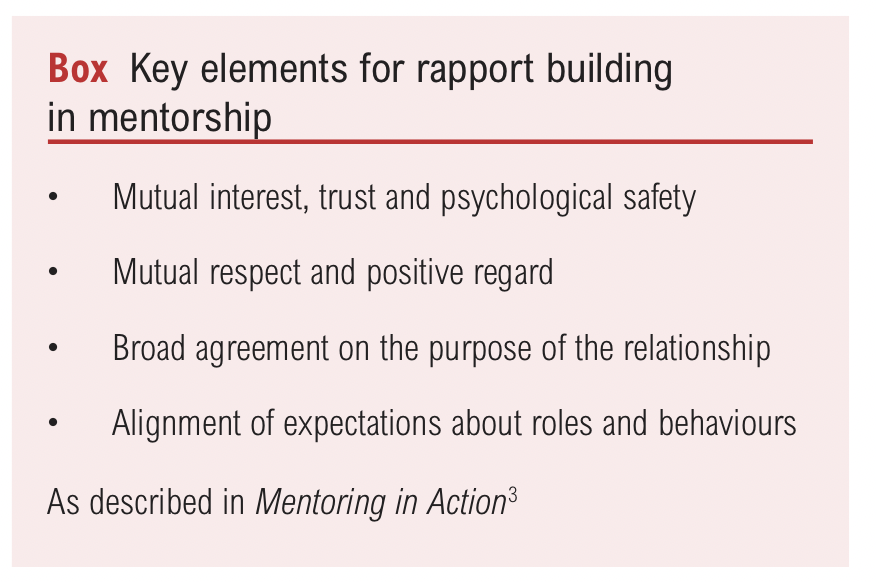
Early meetings typically explore professional background, career trajectory, aspirations and motivations for joining the programme, helping to clarify shared purpose and expectations. Establishing this alignment may take time and goals may evolve as careers develop.
Within vascular surgery, psychological safety is essential. The specialty is technically complex and carries significant responsibility and surgeons must feel able to discuss uncertainty, complications, leadership challenges and career transitions openly, without fear of judgement. Investing in trust and clarity at the outset lays the foundation for productive goal-focused partnerships and determines the level of honesty, insight and growth that the mentoring journey can achieve.
Phase 2: Direction setting
Direction setting involves establishing what the relationship intends to achieve and how time together will be structured. Goals are often initially broad – leadership development, academic progression, resilience – before becoming more defined. For some vascular surgeons this may involve preparing for consultant transition, developing operative confidence, shaping an academic portfolio or taking on service leadership responsibilities. For others, the focus may be resilience, professional identity or achieving a better work–life balance. As circumstances change, aims may be refined accordingly.
Phase 3: Progress making
The progression phase represents the most intensive period of learning in a mentoring relationship. After two or three sessions focused on building rapport and aligning expectations, mentors and mentees move into this stage to make measurable progress. Productive discussions typically involve agreeing the focus of the meeting, exploring issues from the mentee’s perspective, clarifying context, challenging assumptions, analysing and identifying realistic next steps.
Mentors may adopt different roles depending on the context; at times as a professional friend providing confidential space, at others a sounding board, reflector or guide. This flexibility enables the relationship to respond to evolving developmental needs.
A core principle of progression is providing space for reflection. In vascular practice, a reflective approach is particularly valuable; it allows mentees to examine decision-making, navigate setbacks and build professional confidence. The mentor’s role is not to provide solutions but to support the mentee in developing insight, judgement and autonomy.
Phase 4: Winding up
The winding up phase provides an opportunity to consolidate learning, acknowledge growth and express mutual appreciation. Mentor and mentee review what has been achieved, identifying changes in capability, confidence, leadership behaviour or career direction. Acknowledging these developments highlights their significance and reinforces the value of the time invested in the mentoring relationship. Concluding deliberately and thoughtfully not only reflects professionalism but ensures the mentoring relationship ends with clarity and purpose rather than fading without direction.
Phase 5: Moving on
The final phase recognises that, while formal mentoring concludes, professional relationships often evolve rather than disappear. Some partnerships transition into collegiality. In time, mentees may themselves become mentors, strengthening a sustainable culture of support within UK vascular surgery. Moving on symbolises growth. The mentee has progressed beyond the starting point of the relationship and the mentoring has fulfilled its purpose.
As outlined in earlier editorials,1,2 the VSGBI mentorship programme aims to strengthen leadership, resilience and professional development within vascular surgery. Professor Clutterbuck’s five-phase framework provides a clear way to understand this approach.3 Rapport enables trust. Direction provides clarity. Progress generates growth. Winding up consolidates achievement. Moving on signals maturity.
When mentors and mentees engage intentionally across each phase, mentorship becomes more than guidance; it becomes a deliberate investment in leadership and in the future of the vascular specialty.
Article DOI:
Journal Reference:
J.Vasc.Soc.G.B.Irel. 2026;5(2):60-61
Publication date:
February 27, 2026
Author Affiliations:
1. Hull University Teaching Hospitals NHS Trust, Hull, UK
2. Department of Strategy, Leadership and Organisations, Business School, Middlesex University London, London, UK.
3. Consultant Vascular Surgeon, Department of Vascular Surgery, Black Country Vascular Network, Dudley, UK
4. Department of Applied Health Sciences, University of Birmingham, UK.
5. Department of Vascular Surgery, Lancashire Teaching Hospital NHS Foundation Trust, Preston, UK and Chairperson Workforce Committee, VSGBI
Corresponding author:
Judith Long
Research Project Manager, Academic Vascular Surgical Unit, Hull University Teaching Hospitals NHS Trust, Hull, HU3 2JZ, UK
Email: [email protected]