EDITORIALS
Mentorship: an overview
Long J,1 Popplewell M,2,3 Egun A4
Introduction
This is the first in a series of editorials on mentorship in which we will define mentorship, provide evidence for its impact and benefit, and detail why now is the right time to embed it in our specialty and how we plan to do this with a detailed overview of the structure, objectives and early outcomes of the Vascular Society of Great Britain and Ireland (VSGBI) Mentorship Programme.
What is mentorship?
The Oxford English Dictionary defines a mentor as “an experienced and trusted adviser”. In practice, mentorship is a structured relationship in which an experienced professional (senior) supports the personal and professional growth of another (junior). Mentorship programmes aim to develop reciprocal and supportive relationships focused on the mentee’s overall personal and professional development built on trust, openness and commitment.1,2
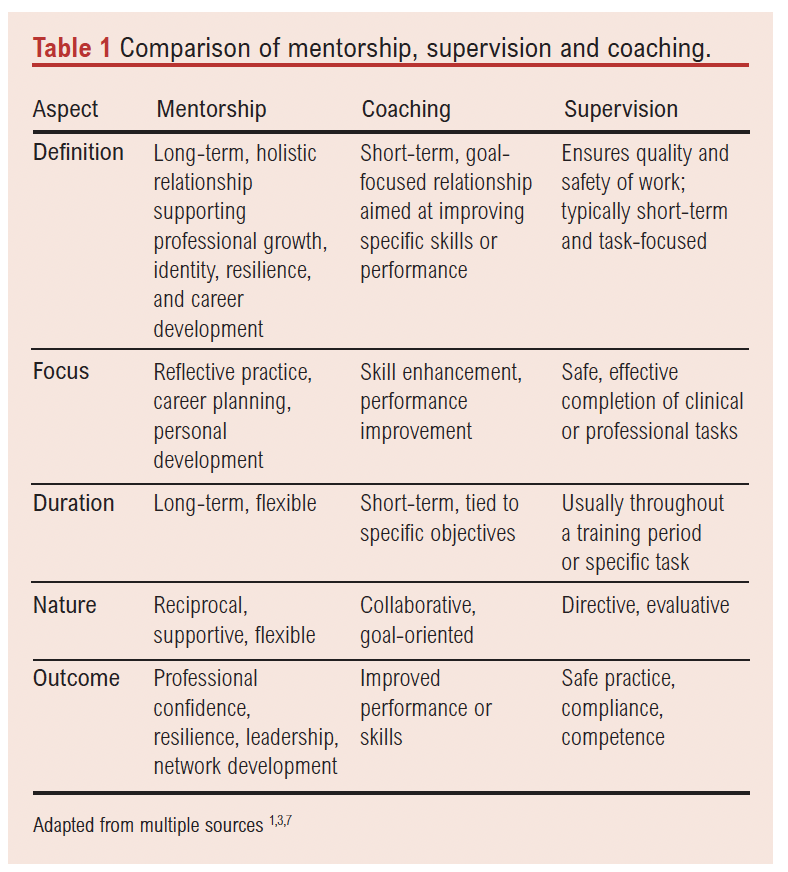
Mentorship differs from coaching and supervision (see Table 1). Coaching is typically short-term and skill-focused, aimed at improving specific performance areas, while supervision ensures safe, effective clinical practice and accountability. By contrast, mentorship is usually a longer-term holistic partnership emphasising reflective practice, professional identity, career development and resilience.3 It may be formal, with agreed goals and timelines, or informal, arising naturally from professional relationships. Both approaches hold value, though formal structured mentorship offers clear expectations, accountability and measurable outcomes.4
Evidence of benefits
Trust-level evaluations show that well-supported mentorship strengthens teams, enhances staff well-being and improves patient care.5 Professional bodies from the General Medical Council (GMC) to the Royal College of Surgeons now advocate mentorship as a key workforce strategy, citing benefits beyond technical skills including decision-making, leadership and work-life balance.6,7
Across surgical specialties, structured mentorship – defined as a formal programme with clear objectives, planned interactions and ongoing evaluation – has consistently demonstrated positive outcomes. In trauma and orthopaedics, it improved career clarity and reduced professional isolation.8 A 2024 national survey in urology found that almost all early-career consultants valued mentorship, with 90% supporting the creation of a formal national programme.9 In ENT, a national mentorship programme showed that participants sought careful mentor–mentee matching and regular review to address career guidance, academic development, psychosocial support and networking needs.10
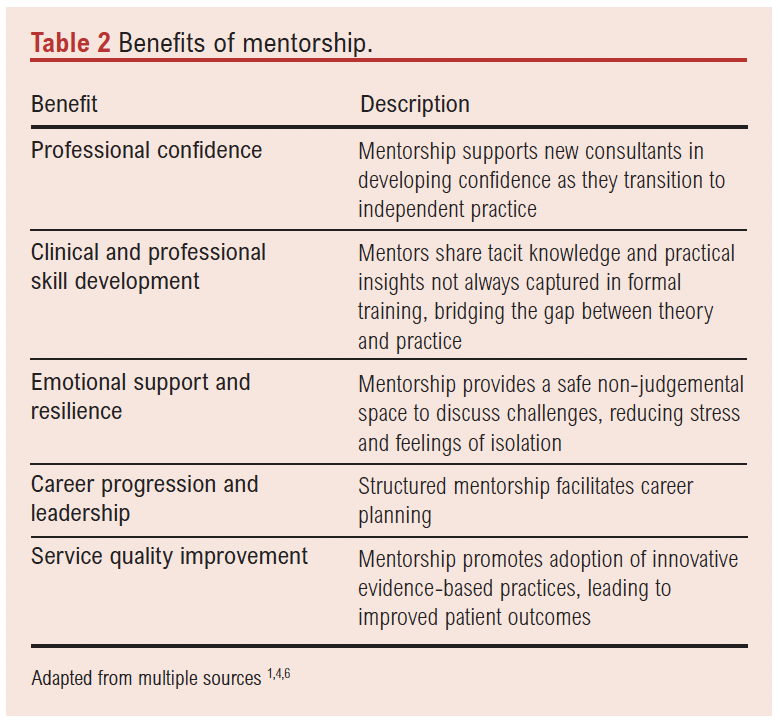
The academic NIHR Mentorship Programme offers an evidence-based nationally recognised framework for supporting early-career healthcare professionals. Notably, it benefits from significant investment and institutional support, making it a flagship model for structured mentorship. An overview of key benefits is summarised in Table 2. Mentees report increased professional confidence, improved reflective practice, emotional support, leadership growth and enhanced service quality.11
Mentorship in vascular surgery
Every surgeon remembers the people who shaped their early career – the colleague whose advice made all the difference, the senior who gave a timely nudge forward or the one who simply listened and understood. Mentorship provides this steady presence of someone more experienced who helps to guide, encourage and challenge at the right time. The transition from trainee to early-career consultant is one of the most demanding phases of a surgical career. New consultants must manage complex clinical decisions, take responsibility for patient outcomes and lead multidisciplinary teams without the ‘safety net’ of supervision from senior colleagues. Increasingly, mentorship is recognised in healthcare as a key factor in successfully bridging the transition from trainee to independent consultant, helping surgeons navigate new responsibilities while continuing to grow personally and professionally.12 Structured mentorship in this situation offers an invaluable safe and confidential space to reflect, learn and build confidence without fear of judgement. Mentors bring perspective and provide practical knowledge that training alone struggles to capture: how to navigate difficult clinical decisions, how to process the emotional impact of complications, how to balance ambition with personal well-being and how to keep going when self-doubt arises.1,13
What’s in it for mentors and mentees?
Mentorship is a reciprocal relationship. For mentees, it offers guidance on clinical decisions, career planning and professional and personal development, facilitating access to professional networks and career opportunities.4,12 The experience can be equally rewarding for mentors, allowing them to give back to the profession, refine leadership and communication skills and gain fresh perspectives from new colleagues. Mentorship encourages reflection on one’s own practice and can inspire new approaches to patient care. By sharing expertise and shaping the next generation of vascular surgeons, mentors reinforce their professional identity and make a meaningful, lasting contribution to the specialty.2,14
Why structured mentorship matters now
Mentorship is not only beneficial for individual surgeons but is also a strategic investment in the future of vascular surgery. Rising work-force pressures, increasing complexity of cases and advances in technology create a challenging environment for new consultants.15 Without structured support, these pressures can contribute to stress, burnout and early attrition, with implications for patient care.16,17
Embedding mentorship now ensures early-career consultants are supported not only clinically but also in developing resilience, leadership skills and professional networks. This approach aligns with broader NHS and Royal College of Surgeons’ initiatives to improve retention, staff well-being and service quality.18 By proactively supporting early-career consultants, mentorship helps reduce the personal and professional costs of burnout, strengthens retention and cultivates a resilient vascular surgery workforce, benefiting individuals, teams and the specialty as a whole.
The VSGBI Mentorship Programme
The VSGBI is establishing a structured mentorship programme, drawing on proven models including the NIHR Mentorship Programme. The first cohort intake will begin in November 2025 with a one-day in-person training session for both mentors and mentees. By providing structured guidance and support during these formative years, the programme will foster safer practice, build stronger teams and cultivate sustainable careers where vascular surgeons can thrive. Importantly, it ensures that the experience and wisdom of senior vascular surgeons are passed forward, shaping the next generation and securing the long-term strength and excellence of the specialty.
Article DOI:
Journal Reference:
J.Vasc.Soc.G.B.Irel. 2025;4(4):166-168
Publication date:
August 28, 2025
Author Affiliations:
1. Hull University Teaching Hospitals NHS Trust
2. Consultant Vascular Surgeon, Department of Vascular Surgery, Black Country Vascular Network, Dudley, UK
3. Department of Applied Health Sciences, University of Birmingham, UK.
4. Department of Vascular Surgery, Lancashire Teaching Hospital NHS Foundation Trust, Preston, UK and Chairperson Workforce Committee, VSGBI
Corresponding author:
Judith Long
Research Project Manager, Academic Vascular Surgical Unit, Hull University Teaching Hospitals NHS Trust, Hull, HU3 2JZ, UK
Email: [email protected]