
EDITORIALS
Mentorship in practice: what being a mentor really involves
Long J,1 Haddock-Millar J,2 Popplewell M,3,4 Egun A5
Introduction
Across previous editorials, we have explored mentorship from several perspectives. We outlined the rationale for mentorship within UK vascular surgery,1 discussed how to build effective relationships,2 and highlighted the core principles that underpin a meaningful mentoring journey.3
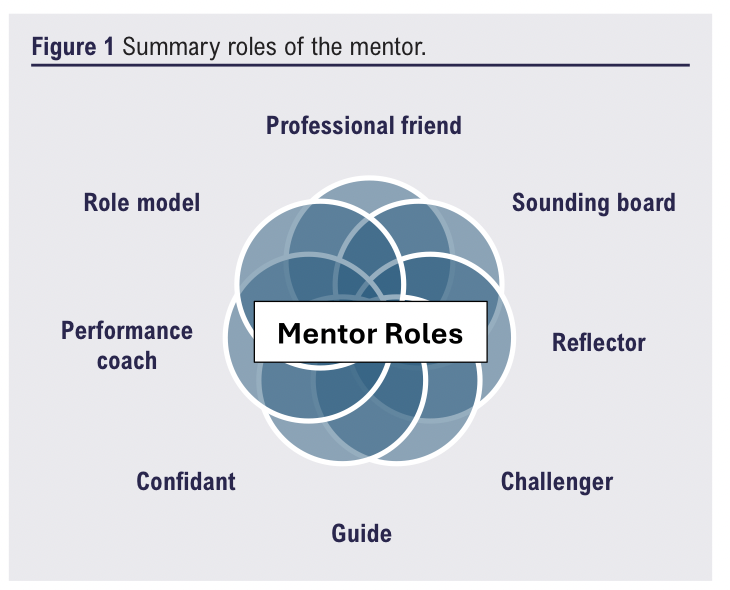
What we have not yet examined in detail is one key practical question: what does a mentor actually do? In practice, mentorship is not defined by a single function but by a range of roles that are adopted in response to the evolving needs of the mentee (Figure 1). This editorial therefore focuses on these roles, exploring how mentors operate in practice, how they adapt across different contexts and how this flexibility underpins effective and impactful mentorship.
The core responsibilities of a mentor
Mentorship in vascular surgery extends beyond technical teaching alone. Effective mentorship should support the development of professional identity, clinical judgement, confidence and resilience alongside clinical expertise. Table 1 outlines key domains of support in which mentorship can contribute meaningfully to the development of individuals within the vascular specialty. These domains are rarely addressed in isolation. Instead, mentorship functions as an ongoing developmental relationship that evolves alongside the mentee’s experience, confidence and stage of training.
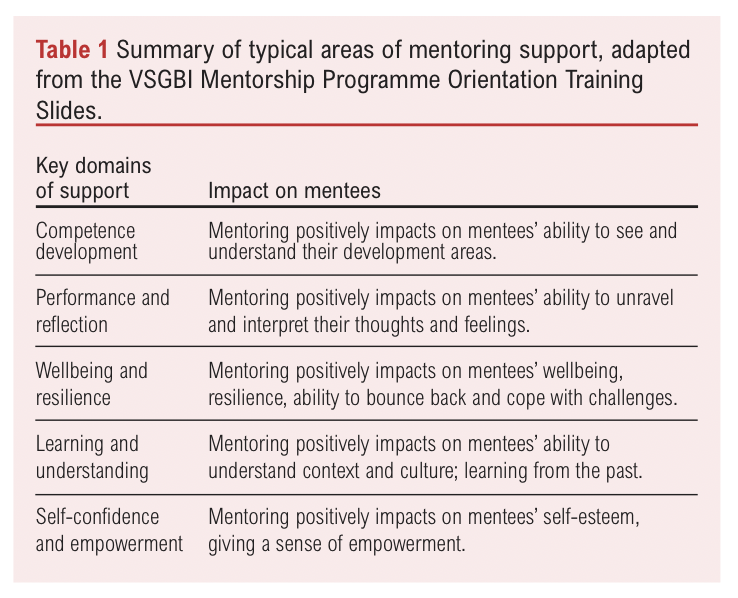
Within vascular surgery, mentoring relationships may begin with practical guidance and support but gradually evolve towards reflection, challenge, career development and professional growth. It is throughout this journey that the different roles of the mentor become most visible and influential.
The roles of a mentor
The role of a mentor is dynamic, shaped by both the context of the relationship and the evolving needs of the mentee over time. While the responsibilities of mentorship may be broad, the way in which mentors deliver this support is equally important. Effective mentors do not operate within a single fixed role, they adapt their approach according to the situation and the nature of the discussion.
Table 2 summarises eight commonly described mentor roles, synthesised from established frameworks in a variety of contexts, including healthcare and professional education. These roles are underpinned by adaptability as mentees require different forms of support at different stages of their development. Effective mentors recognise and respond to these evolving needs, often moving fluidly between roles (sometimes even within the same mentoring session) to provide appropriate guidance, challenge, reflection or support.
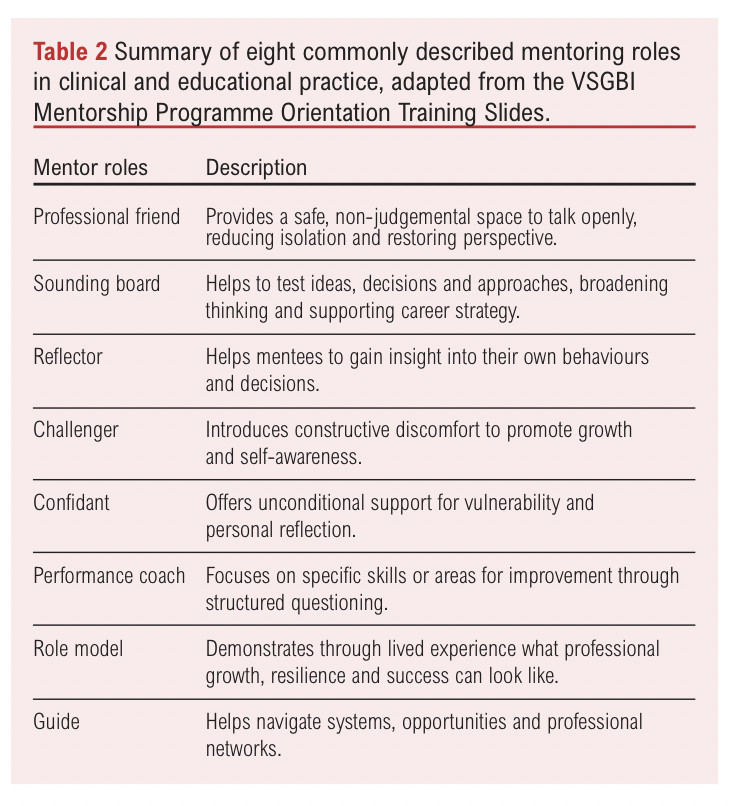
At the first Vascular Society of Great Britain and Ireland (VSGBI) Mentorship Orientation Day last November, led by Professor Julie Haddock-Miller, participants were introduced to the different roles that a mentor may adopt within a mentoring relationship. The following section revisits these roles in greater depth, exploring the defining characteristics of each and how they contribute to effective mentorship in practice.
Mentor roles
The professional friend
One of the most immediately important roles is that of the professional friend. In this space, the mentor provides a safe and confidential environment where the mentee can speak openly about concerns, frustrations or uncertainties that may not be typically shared elsewhere. This role is not focused on instruction or correction, but on reassurance, normalisation and support. It helps mentees to feel heard and less isolated, and is a valuable space to vent. This role sometimes crosses over into the role of cheerleader.
The sounding board
Alongside the role of professional friend, the sounding board creates a space in which ideas, decisions and uncertainties can be explored openly and constructively. Rather than simply providing answers, the mentor supports the mentee in testing their thinking, considering consequences and refining their judgement. This is particularly valuable in the development of clinical reasoning and strategic career planning, where uncertainty is inevitable and reflective discussion is essential. Through this process, the mentor helps the mentee to develop a more strategic approach to their professional life, encouraging thoughtful decision-making, prioritisation and an understanding of when to accept opportunities and when to decline them.
The reflector
Closely linked to the role of sounding board is the role of the reflector. In this capacity, the mentor helps the mentee to step back and make sense of their experiences. By holding up a metaphorical mirror, the mentor enables greater self-awareness, helping the mentee to recognise patterns in behaviour, responses and decision-making. Over time, this deepens insight and supports more intentional professional development.
The challenger
At times, mentorship requires challenge. The challenger role is deliberately more direct, encouraging critical thinking and pushing the mentee beyond their comfort zone. While this may introduce discomfort, it is often where the most significant learning occurs. Constructive challenge helps to refine judgement, expose assumptions and build resilience in decision-making. By encouraging the mentee to consider alternative perspectives and question established patterns of thinking, the mentor promotes deeper reflection and greater self-awareness. The mentor may also help the mentee to recognise the language of self-doubt and imposter syndrome, supporting them to develop confidence and a more balanced perception of their abilities.
The confidant
Equally important is the confidant role. In this space, the mentor offers unconditional support, allowing the mentee to express vulnerabilities, doubts and fears without judgement. This aspect of mentorship is often understated but is essential, particularly in high-pressure clinical environments where emotional load is significant. It provides validation and reassurance at moments when they are most needed.
The performance coach
More structured support is provided through the performance coach role. Here, the focus narrows to specific skills or areas for development. The mentor uses questioning and guided reflection to help the mentee to identify solutions and improve performance. This role is especially relevant in technical or procedural specialties, where incremental improvement and targeted feedback are key to progression. At times, a non-directive coaching approach is most effective, enabling the mentee to generate their own solutions.
The role model
The mentor may also serve as a role model, one of the most recognisable and valued roles within mentorship. In this capacity, the mentee learns not only through direct advice but also through observing how the mentor navigates challenges, balances competing demands and responds to setbacks. Importantly, this includes hearing about the mentor’s own experiences of failure, uncertainty and recovery, which often provide some of the most meaningful learning opportunities. Seeing success as an evolving process rather than a fixed endpoint can be highly transformative for mentees. Role models often embody qualities, behaviours and professional values that the mentees admire and aspire to develop within themselves. Learning about the mentor’s personal and professional journey can provide reassurance, perspective and practical insight from someone who has faced similar challenges and is willing to share what they learned along the way.
The guide
Finally, the mentor acts as a guide. This involves helping the mentee to navigate systems, identify opportunities and build professional networks. It may include signposting, facilitating connections, or helping the mentee understand how to access resources and progress within the specialty. In many ways, this role situates the mentor within the broader professional landscape, supporting not just individual development but integration into the wider community.
What makes mentorship effective is not the presence of any single role, but the ability to move between these roles fluidly. A single conversation may involve support, reflection, challenge and guidance all at once. The skill lies in recognising what is needed at a given moment and responding appropriately. From the mentee’s perspective, it is equally valuable to understand these roles and consider which are most helpful at different stages of development.
The value of being a mentor
Stepping into a mentoring role can be transformative in itself. Although mentorship requires time, emotional investment and thoughtful engagement, it also offers considerable personal and professional rewards. There is deep professional satisfaction in supporting the development of others, watching confidence grow, skills mature and careers evolve over time.
Mentorship also enhances the mentor’s own development. It strengthens communication skills, encourages self-reflection and often challenges mentors to examine their own clinical reasoning, leadership style and decision-making processes more clearly. Many mentors find that guiding others enhances their own understanding and perspective.
Importantly, mentorship is also a way of giving back to the specialty. Through the mentor role, experienced surgeons play a vital part in developing the next generation of clinicians, while also strengthening the quality, continuity and long-term resilience of the vascular specialty as a whole.
Conclusion
Effective mentorship is defined not by a single approach but by adaptability and the ability to move fluidly between roles in response to the evolving needs of the mentee. For those already in vascular surgical practice, this editorial has hopefully encouraged reflection on the value of becoming a mentor. The specialty relies on experienced surgeons willing to share not only their technical expertise but also their judgement, perspectives and lived experience.
Article DOI:
Journal Reference:
J.Vasc.Soc.G.B.Irel. 2026;5(3):117-119
Publication date:
May 27, 2026
Author Affiliations:
1. Hull University Teaching Hospitals NHS Trust, Hull, UK
2. Department of Strategy, Leadership and Organisations, Business School, Middlesex University London, London, UK.
3. Consultant Vascular Surgeon, Department of Vascular Surgery, Black Country Vascular Network, Dudley, UK
4. Department of Applied Health Sciences, University of Birmingham, UK.
5. Department of Vascular Surgery, Lancashire Teaching Hospital NHS Foundation Trust, Preston, UK and Chairperson Workforce Committee, VSGBI
Corresponding author:
Judith Long
Research Project Manager, Academic Vascular Surgical Unit, Hull University Teaching Hospitals NHS Trust, Hull, HU3 2JZ, UK
Email: [email protected]