EDITORIALS
Robotic assisted vascular surgery adoption in the UK: future-proofing with prudence
Ninkovic-Hall G,1 Sritharan K,2 Ghosh J3
Introduction
Robotic assisted surgery is no longer a novel frontier, but the operating reality for a growing proportion of surgical disciplines. Robotic systems filter out natural hand tremor and scales movement, allowing enhanced accuracy. A three-dimensional (3D) high-definition camera gives a magnified view of deep or narrow anatomical spaces that are difficult to reach in open surgery. It therefore offers greater precision, ergonomics and minimally invasive access to reduce patient trauma, recovery time and surgeon fatigue, and is supported by NHS England and Getting It Right First Time (GIRFT).1
Yet within vascular surgery in the UK, clinical and educational adoption remains non-existent, with no UK centres offering robotic open vascular surgery and only Imperial College Healthcare NHS Trust offering clinical experience with robotic endovascular procedures.2 While most surgical fields have integrated robotics into mainstream NHS practice, vascular surgery stands alone at a crossroads.
Is this current position in the field of robotics one of prudence – or paralysis? Why has UK vascular surgery not embraced robotics or considered how it could be utilised in vascular practice?
What is robotic assisted vascular surgery?
Robotic assisted vascular surgery (RAVS) uses platforms such as the da Vinci system to perform open vascular procedures through minimally invasive console control. It differs from robotic endovascular systems (Magellan (Hansen Medical, Mountain View, California, USA), CorPath GRX (Corindus Vascular Robotics/Siemens Healthineers, Waltham, Massachusetts, USA/Erlangen, Germany)) that steer intraluminal devices to reduce operator radiation exposure and improve precision.3
In RAVS, the surgeon may perform standard open techniques robotically, including dissection, vessel control and suturing, but with the advantages of enhanced dexterity, visualisation and precision enabled by wristed instruments, tremor filtration and 3D high-definition optics. This has the advantage of allowing access to anatomically challenging regions with minimal tissue disruption.4
Crucially, RAVS is not confined to replicating traditional open procedures. One of its most compelling applications lies in hybrid procedures, where robotic exposure, dissection or conduit formation is combined with endovascular intervention in a single operative setting.
The surgical innovation divide
Robotic platforms such as the da Vinci Xi (Intuitive Surgical, Sunnyvale, California, USA), Versius (CMR Surgical, Cambridge, UK) and Hugo (Medtronic, Dublin, Ireland) systems are now standard in operating theatres across the UK. In urology, colorectal and gynaecology, robotics has moved from innovation to infrastructure, underpinned by national simulation hubs and structured training pathways. NHS England’s 2025 GIRFT report advocates shared access and national pathways.1
Vascular surgery, however, remains largely absent from this momentum. There are currently no defined robotic competencies in the Joint Committee on Surgical Training (JCST) vascular curriculum, and no formal vascular-specific robotic training centres within the UK. A recent Royal College of Surgeons (RCS) England Multi-Specialty Robotic Surgery Training Roundtable, established to shape national robotic training standards, has further highlighted this vacuum.
This hesitancy is particularly striking given that robotic procedures involving major blood vessels are already being performed in the UK and internationally across other surgical disciplines. These include robotic coronary artery bypass grafting, nephrectomy with inferior vena cava tumour thrombectomy, renal and iliac vein reconstructions, renal transplants,5 robotic first rib resections and now also cardiac transplants.6 These operations demonstrate that robotic handling of arteries and veins is not only theoretically feasible but is already being done – just not by vascular surgeons.6 Without a clear strategic plan, vascular surgery within the UK is being left behind in what is rapidly becoming the dominant paradigm for minimally invasive high-precision surgery.
From feasibility to functionality: what the evidence shows
Over the past decade, international experience has moved beyond isolated case reports to a consistent series to demonstrate that robotic assistance can be applied safely and effectively to aorto-iliac reconstruction, ilio-femoral and aorto-femoral bypass, type 2 endoleak branch ligation, renal/visceral artery revascularisation and major venous reconstruction including renal vein transposition and inferior vena cava tumour thrombectomy – with acceptable perioperative outcomes when delivered by experienced teams.6-10
The largest single-centre RAVS experience to date, from Prague, reports 668 RAVS operations for occlusive and aneurysmal disease and post-endovascular aneurysm repair endoleak, of which 96% were completed robotically with 3.6% conversions and a 0.45% 30-day mortality. These data illustrate the feasibility, reproducibility and safety of RAVS once the learning curve is achieved.11 Technical advancements such as sutureless anastomotic adjuncts and single-port architectures further improve access and ergonomics and are likely to lower barriers to wider adoption.10,12
Despite this progress, widespread uptake remains low. Systematic reviews estimate only ~2000–5000 RAVS procedures have been performed worldwide since inception,10,13 a vanishingly small fraction of the >14 million da Vinci procedures performed globally by >76,000 surgeons.4 Much of the vessel-intense robotic work is currently undertaken by cardiac, urological or transplant teams, highlighting a gap in infrastructure and pathways – platform access, training routes, proctoring and governance – within the vascular specialty, rather than any limitation in surgeon skill or technology.6
The experiences gleaned from these approaches in other specialities may be harnessed and adapted for specific vascular procedures. Port strategies, workflow, credentialling and hybrid lists design from cardiac, urology and transplant programmes are readily transferable to vascular surgery and offer a pragmatic starting point for UK pilot work.5,6
From consensus to capability: a targeted UK implementation plan
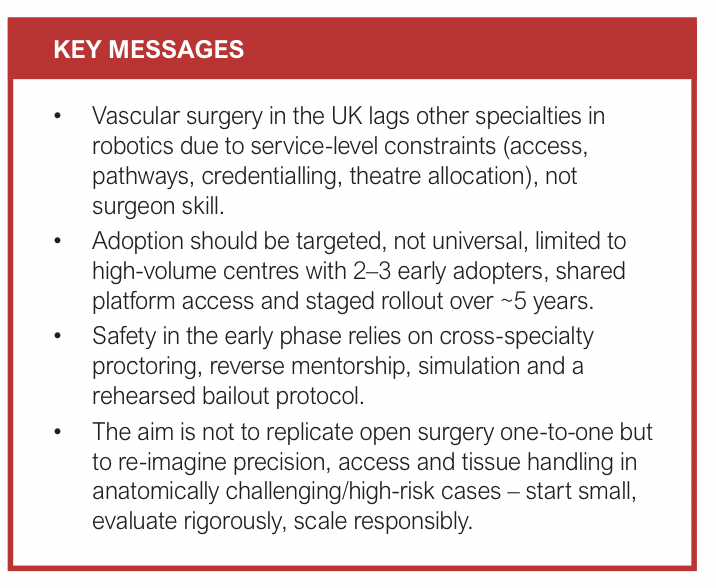
Integration of RAVS into UK practice requires a coordinated national strategy. Key steps include development of pilot centres, defined training and credentialing pathways, strict governance and evaluation, and incremental scaling tied to performance outcomes. Above all, the goal is not one of replication of open surgery but re-imagining precision, access and tissue handling in anatomically complex or high-risk cases where robotics can genuinely add value.
This five-phase pathway mirrors established UK robotic rollout in other specialities and aligns with the Idea, Development, Exploration, Assessment, Long-term study (IDEAL) framework for surgical innovation, the RCS England RAS Guide and the NHS England/GIRFT implementation plan – each emphasising proctoring, simulation, staged case complexity and prospective registry evaluation.1,14,15
1. Pilot centre: Early adoption should be limited to a small number of large high-volume centres, each nominating 2–3 early adopters and committing to a staged five-year rollout.
2. Credentialing: This approach should translate the UK pan-specialty Delphi consensus on training and credentialing – covering simulation, modular skills, objective metrics – into vascular practice. This embeds the accepted minimum standards for robotic proficiency and aligns with General Medicines Council (GMC) credentialling principles and NHS England/GIRFT policy on cross-specialty collaboration and evaluation.1,14,16
3. Governance: This must be endorsed from case one; CE-compliant indications, novel-tech consent, multidisciplinary team case selection and a rehearsed bailout protocol (including the following: pre-marked conversion incision, open instruments in theatre, endovascular balloon occlusion available, rapid undock drill).
4. Evaluation: All cases should enter a prospective registry with predefined Key Performance Indicators such as conversion <10%, Clavien–Dindo III–V <5%, length of stay reduction versus open, downward trends in console time and routine reporting to GIRFT.
5. Scaling: Progress to ring-fenced sessions, business case growth and ultimately a curriculum-defined competency and fellowship pathway should be contingent on meeting safety and value thresholds.
Early adoption should focus on hybrid ‘starter’ cases – for example, robotic-assisted first rib resections and aorto-iliac exposure/ anastomosis – delivered on shared da Vinci sessions rather than dedicated lists, while guaranteeing simulator access, including out-of-hours, for trainees. Cases should be proctored, including cross-specialty proctors, and should explicitly support reverse mentorship; this sits alongside a metrics-based credentialling pathway (simulation benchmarks, mentored cases, video/console-metric review) before independent practice.6,14,16 In robotics, seniority in service does not necessarily equate to seniority in skill. Many UK vascular trainees already have console exposure via thoracic/ urology/colorectal rotations; formal reverse mentorship should be normalised so trainees support consultants during early adoption. This must sit within a credentialled pathway – simulation benchmarks, mentored/live cases and objective metrics – aligned to UK guidance and pan-specialty consensus.14,16,17
Why has vascular hesitated?
Reluctance within UK vascular surgery reflects structural and practical constraints rather than potential ability. Since separating from general surgery in 2012, the specialty lacked the early robotic exposure available to peers in other training pathways. This has denied consultants the progression from non-arterial robotic work (soft tissue/retroperitoneal/first rib/lymphatic) to robotic assisted arterial reconstruction. Added barriers include the absence of defined robotic competencies, uncertain trust-level credentialling/medico-legal pathways, and limited access to robotic platforms already saturated by other services.1,14
Cost and access remain a critical constraint. NHS freedom of information (FOI) shows annual maintenance contracts in the region of £110k–£170k per robot, with per-procedure costs rising steeply at low volume. Centres performing fewer than 200 cases/year typically exceed £3000 per case (before staff/theatre overheads), making business cases hard to justify without shared platforms and cross-specialty throughput.18–20
A real clinical anxiety among robotically assisted surgeons is the ‘red-out’ – referring to uncontrolled bleeding in a closed insufflated field – but this is protocol-manageable with rehearsed rapid undocking, a pre-marked bailout incision, open vascular instruments on the table, pre-planned proximal/distal control (including endovascular balloon occlusion) and explicit conversion thresholds. Centres crossing the learning curve report high completion, low conversion and low 30-day mortality.6,13
Finally, while the technology is mainstream in the NHS and NICE has now listed da Vinci X/Xi/SP, Hugo, Senhance (Asensus Surgical, Durham, North Carolina, USA) and Versius for use during evidence generation, vascular-led evidence remains sparse. Demonstrating tangible patient benefits including reduced blood loss, reduced length of stay and improved recovery through UK registry outcomes is essential.21
Conclusion
RAVS complements rather than replaces traditional open or endovascular practice. It is an opportunity to expand and fill the procedural gaps between them. It offers an opportunity to enhance precision and expand treatment options for complex anatomy. The prudent path forward is structured, evidence-led adoption – starting small, evaluating rigorously and scaling responsibly. Our specialty has an exciting opportunity to think differently, keep an open mind and begin preparing ourselves for the next stage in the evolution of vascular surgery.
Article DOI:
Journal Reference:
J.Vasc.Soc.G.B.Irel. 2025;5(1):4-7
Publication date:
November 24, 2025
Author Affiliations:
1. Specialist Registrar in Vascular Surgery, Manchester University Foundation Trust, Health Education England North West, Manchester, UK
2. Consultant Vascular Surgeon, Department of Vascular Surgery, York & Scarborough Teaching Hospitals NHS Trust, York, UK
3. Consultant Vascular Surgeon, Department of Vascular Surgery, Manchester University Foundation Trust, Manchester, UK
Corresponding author:
Mr George Ninkovic-Hall
Specialist Registrar in Vascular Surgery, Manchester University Foundation Trust, Health Education England North West, Manchester, M13 9WL, UK
Email: [email protected]