EDITORIALS
Surgical wounds healing by secondary intention: the SWHSI-2 trial and implications for practice
Arundel CE,1 Chetter IC2
Introduction
Following surgery, when wound closure is not possible or if closed wounds dehisce, they are usually left open to heal by secondary intention through the formation of granulation tissue. The estimated UK prevalence of wounds healing in this way is 4.1 per 10,000 population.1
The median time to surgical wounds healing by secondary intention (SWHSI) is prolonged with a previous estimate of 86 days (95% CI 75 to 130), with foot and leg wounds taking additional time to heal (182 and 127 days, respectively).2 With prolonged healing, wound infection, hospital readmission and further surgical procedures are common, significantly impacting health-related quality of life and healthcare costs2-4 with a mean monthly cost estimated to be between £1500 and £2400 depending on the treatments used.5
A widely used treatment for these wounds is Negative Pressure Wound Therapy (NPWT), which applies a controlled negative pressure (vacuum) to wounds via a special dressing. It is suggested that the negative pressure generated aids wound healing by removing exudate and infective materials, reducing oedema and increasing perfusion and granulation.6 Despite the widespread use of this device, there was until recently limited rigorous evidence for its clinical and cost effectiveness in the context of augmenting SWHSI healing.7
SWHSI-2 trial design
The SWHSI-2 trial was a pragmatic, two-arm, parallel group, randomised controlled superiority trial which assessed the clinical and cost effectiveness of NPWT versus usual care (no NPWT) in treating SWHSI.8,9
Between 15 May 2019 and 13 January 2023, 686 participants were recruited from 28 UK NHS trusts, randomised to receive either NPWT (n=349) or usual care with no NPWT (n=337) and were followed for 12 months.8,10
The primary outcome was time to healing (full cover with no scab in days since randomisation), which was collected via weekly telephone contact with participants alongside clinical secondary outcomes (surgical site infection and treatment, hospital readmission and further procedures, current treatment and reasons for treatment change (if applicable) and death). Postal questionnaires collected pain, health-related quality of life and resource use at 3, 6 and 12 months.8,10
SWHSI-2 trial results
The median participant age was 63 years (IQR 55–72 years) and most participants were male (n=513, 74.8%) and of white ethnicity (n=630, 91.8%). Most participants recruited had a SWHSI located on the foot (n=551, 80.3%) or leg (n=69, 10.1%) arising following vascular surgery (n=619, 90.2%). Comorbidities were common including diabetes (n=549, 80.0%), cardiovascular disease (n=446, 65.0%) and/or peripheral vascular disease (n=349, 50.9%).8,10
Participants allocated to NPWT received the treatment for a mean duration of 46.6 days (SE 4.1), following which they received usual care dressings. Participants allocated to usual care received standard dressings for a mean duration of 164.3 days (SE 4.7).10
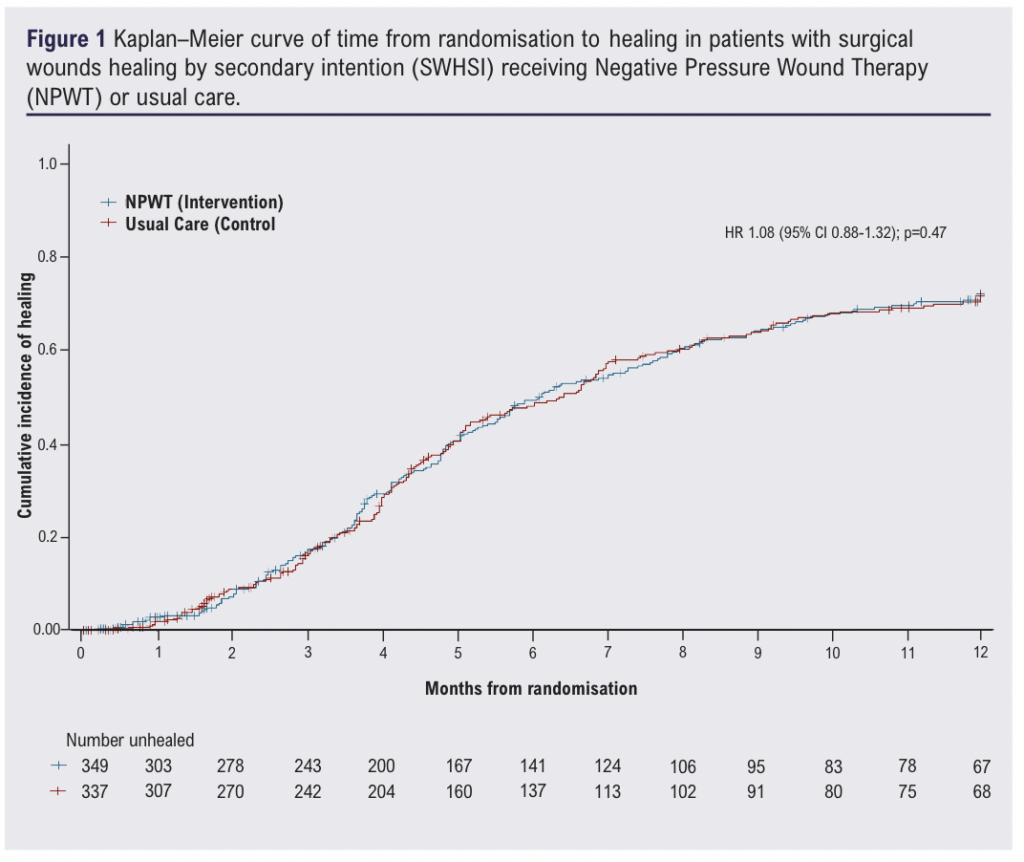
Median time to healing was 187 days with NPWT versus 195 days with usual care, with no evidence that NPWT reduced the time to wound healing compared with usual care (HR 1.08, 95% CI 0.88 to 1.32, p=0.47; Figure 1).8,10
The odds of readmission, reoperation, surgical site infection and antibiotic use were slightly higher and the odds of amputation or death slightly lower for NPWT participants, but the results were not clinically or statistically significant. Bluebelle Wound Healing Questionnaire, quality of life and wound pain scores were not statistically significantly different at any timepoint. Serious adverse events were rare (9 NPWT vs 5 usual care participants).8,10
Cost effectiveness analyses concluded that NPWT generates higher costs and marginally higher gains than usual care, although the findings were not statistically significant. The probability of NPWT being cost effective was under the recommended NICE cost effectiveness thresholds (£20,000 and £30,000).10,11
What does this mean for practice?
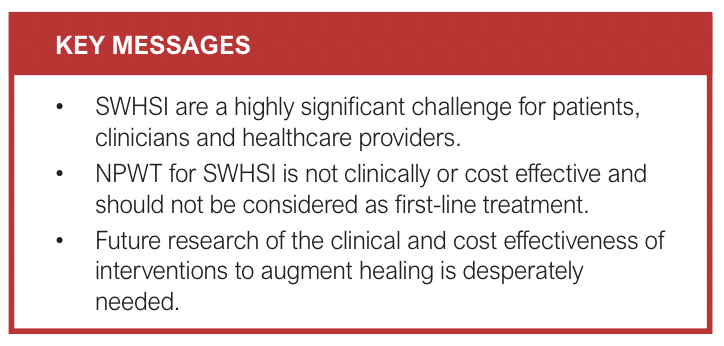
Prior to SWHSI-2, the common clinical view was that NPWT use was associated with shorter wound healing times and reduced complications. The study results, however, refute this widely held view. Based on the outcomes assessed, NPWT is not clinically or cost effective in augmenting healing in patients with SWHSI, particularly for patients with wounds located on the lower limb and/or in those with comorbidities such as diabetes, cardiovascular disease and/or peripheral vascular disease.10
Healthcare practitioners should therefore reflect on this evidence when making decisions regarding wound healing treatments for patients. It is important to note that the SWHSI-2 trial did not measure the impact of NPWT on wound and exudate management, so trial findings cannot be used to inform the use of NPWT for these and other non-healing outcomes. It is probably too early to evaluate the full impact of this trial on NPWT prescriptions, wound care guidelines and curricula which will emerge over the next few years. However, early indicators from a recent survey suggest it will have a profound effect with over 50% of respondents reporting a reduction in overall NPWT use.12
NPWT was widely used in practice. The lack of supportive high-quality evidence resulted in the routine use of an ineffective and costly intervention for a considerable time. This highlights the importance of timely randomised evaluations to inform practice, and raises questions about how non-medicinal products such as wound dressings are introduced into routine practice without robust supporting evidence for their effectiveness.10
Future work
The SWHSI-2 trial provided stark real-world data on the outcomes for (predominantly diabetic) patients with leg and foot wounds following vascular surgery. At 12 months fewer than 60% of wounds had healed and, of those that did heal, the median time to healing was approximately 6 months. The incidence of clinical events was perhaps higher than expected: wound infection 31%, re-operation 23%, major lower limb amputation 11% and death 12%. These wounds continue to be a highly significant problem for patients, clinicians and health services and clearly merit ongoing future research.
SWHSI-2 has provided the first robust assessment of NPWT compared with standard dressings for healing of SWHSI. Given the prolonged, complex and expensive healing trajectory for these wounds and the associated impacts on patient quality of life and healthcare resource use,2-5 identifying and evaluating the clinical and cost effectiveness of other treatments for the healing of SWHSI remains crucial.
Patients and clinicians support this; acceleration of wound healing was ranked second in the recent James Lind Vascular Research priority setting, followed by improvement to quality of life.13
As described in the full SWHSI-2 NIHR report,10 key clinical questions requiring evaluation are:
• Which treatments (eg, dressings or surgical procedures) are clinically and cost effective for the healing of SWHSI and does wound location impact on treatment clinical or cost effectiveness?
• How can surgical site infections in SWHSI be prevented or best treated and does this augment healing?
• What is the clinical and cost effectiveness of NPWT versus usual care for wound management or exudate control?
Article DOI:
Journal Reference:
J.Vasc.Soc.G.B.Irel. 2026;Online ahead of publication
Publication date:
November 25, 2026
Author Affiliations:
1. York Trials Unit, University of York, York, UK
2. Hull York Medical School, Hull and University of Hull, Hull, UK
Corresponding author:
Catherine Arundel
SWHSI-2 Trial Manager,
York Trials Unit, Lower Ground Floor ARRC Building,
Department of Health Sciences, Faculty of Science,
University of York, York
YO10 5DD, UK
Email: catherine.arundel@ york.ac.uk