
ORIGINAL RESEARCH
Outcomes of infra-inguinal bypass surgery in patients with heart failure
Baker TG, Harker JJ, Rawlins J, Haydock P, Sobocinski J, Patterson BO
Plain English Summary
Why we undertook the work: Heart failure is common in patients with peripheral arterial disease and may increase the risks of major vascular surgery.
What we did: We studied patients with severe peripheral arterial disease who underwent surgery to improve blood flow to the leg, comparing those with and without heart failure.
What we found: Patients with heart failure had a larger amount of co-existing medical conditions and a higher risk of dying during follow-up, including within the first year after surgery. However, there was no difference in grafts becoming blocked in patients with and without heart failure.
What this means: These findings suggest that heart failure seems to be an important factor when assessing and counselling patients before bypass surgery. Rather than being an automatic reason to avoid surgery, identifying heart failure may help clinicians optimise patients before surgery and ensure close medical management of heart failure after their operations.
Abstract
Background: Heart failure (HF) is common among patients with chronic limb-threatening ischaemia (CLTI) and is associated with adverse outcomes following non-cardiac surgery. However, its impact on infra-inguinal bypass graft patency and limb outcomes remains unclear. Anecdotally, many surgeons will report HF as an independent contributor to future graft failure/occlusion. This study aimed to evaluate graft patency, mortality and limb salvage following infra-inguinal bypass surgery in patients with and without HF.
Methods: A retrospective cohort review was conducted using patient data from the Wessex Vascular Network between January 2020 and December 2023. Patients undergoing infra-inguinal bypass for CLTI were included and stratified by the presence of a cardiology-confirmed diagnosis of HF prior to the index bypass. Patients undergoing bypass for other indications or non-bypass procedures were excluded. The primary outcome was probability of graft occlusion over time. Secondary outcomes included patient survival and amputation-free survival (AFS) following surgery.
Results: Of 211 patients undergoing infra-inguinal bypass, 40 (19.0%) had HF. Median follow-up was similar between the groups (46 vs 45 months, p=0.68). There was no significant difference in graft occlusion between the groups (p=0.365) when accounting for competing risks of death and major limb amputation. One-year survival was 77.5% (95% CI 65.6% to 91.6%) in the HF cohort compared with 98.1% (95% CI 96.1% to 100%) in the non-HF cohort, declining to 57.0% (95% CI 41.3% to 72.7%) and 84.3% (95% CI 78.3% to 90.8%), respectively, at three years (p<0.001). On Cox regression analysis, HF was associated with an increased hazard of mortality following infra-inguinal bypass (HR 2.44, 95% CI 1.47 to 4.06; p<0.001). AFS was also lower in the HF cohort. One-year AFS was 77.5% (95% CI 65.6% to 91.6%) in the HF cohort compared with 87.1% (95% CI 82.2% to 92.3%) in the non-HF cohort, declining to 47.0% (95% CI 33.1% to 66.7%) and 66.8% (95% CI 59.8% to 74.5%), respectively, at three years (p=0.009), while amputation rates were similar (10.0% vs 14.0%).
Conclusion: Infra-inguinal bypass surgery achieves comparable graft patency and limb salvage in patients with and without HF. However, HF is associated with a larger burden of co-existing comorbidities and significantly higher early and late mortality.
Introduction
Chronic limb-threatening ischaemia (CLTI) is the most advanced manifestation of peripheral arterial disease (PAD) and has a poor prognosis, with reported 1-year mortality and major limb loss rates of 20–25%. Revascularisation remains the cornerstone of management, offering superior survival and limb salvage compared with primary amputation, which is associated with perioperative mortality of up to 20% and 5-year mortality approaching 85% in elderly patients.1–3
Heart failure (HF) affects nearly 900,000 individuals in the UK, is twice as prevalent among those with PAD, and is an important comorbidity in this setting.1 It is a well-recognised risk factor for adverse outcomes following non-cardiac surgery. Large population-based studies demonstrate that patients with HF experience higher perioperative mortality (4.8% vs 0.78% in those without HF) and increased rates of cardiovascular complications including myocardial infarction, stroke, pulmonary embolism and cardiac arrest.2 The mortality risk varies according to HF acuity, with the highest rates observed in patients with acute decompensation.4
Anecdotally, many surgeons will report HF as a contributor to future graft failure/occlusion. Research specifically addressing the effect of HF on infra-inguinal bypass outcomes is limited. Available evidence suggests that short-term graft patency is not impaired by HF, even in acute presentations.5 However, HF has been consistently associated with higher postoperative morbidity including pneumonia, respiratory complications, sepsis, re-operation, and with increased 30-day mortality and prolonged hospitalisation.5 While large registry studies have established general survival predictors in CLTI including age, renal function and functional status,3,6 the independent contribution of HF to long-term outcomes following bypass remains less clear. Existing studies are constrained by heterogeneous patient populations, variable definitions of HF acuity and limited follow-up, making it difficult to stratify risk accurately or guide treatment selection.5,6
Given these limitations, further investigation is needed. This study aimed to evaluate graft occlusion rates, mortality and limb outcomes following infra-inguinal bypass surgery in patients with HF compared with those without HF, addressing a key evidence gap in the management of this high-risk population.
Methods
Study design and setting
This retrospective observational cohort review was conducted across the Wessex Vascular Network, analysing patients undergoing infra-inguinal bypass surgery between January 2020 and December 2023. Data were retrospectively collected from electronic inpatient and outpatient medical records, operative reports, vascular imaging databases and duplex ultrasound surveillance records.
The Wessex Vascular Network provides regional arterial services, with complex lower limb revascularisation performed within a centralised vascular service. Patients undergoing infra-inguinal bypass were managed through a standardised postoperative surveillance pathway incorporating clinical review and duplex ultrasound assessment.
The study was registered as a service evaluation and approved by the local clinical governance department.
Patient selection
All patients undergoing infra-inguinal bypass surgery for CLTI between January 2020 and December 2023 were eligible for inclusion. CLTI was defined by the presence of ischaemic rest pain and/or tissue loss requiring revascularisation.
Patients were stratified according to the presence or absence of pre-existing HF. HF was defined as a cardiology-confirmed diagnosis documented within the electronic medical record prior to the index bypass procedure. HF phenotype was categorised as HF with reduced ejection fraction (HFrEF) or HF with preserved ejection fraction (HFpEF) according to the documented cardiological diagnosis and preoperative echocardiogram assessment where performed. NYHA functional class at the time of surgery was retrospectively determined from the preoperative assessment and anaesthetic records, based on the clinical assessment performed by a consultant anaesthetist prior to the index procedure.
Patients undergoing bypass for alternative indications, including acute limb ischaemia or popliteal aneurysm exclusion, and those undergoing non-bypass lower limb revascularisation procedures (eg, common femoral endarterectomy or endovascular intervention alone) were excluded. Patients with incomplete baseline or follow-up data were excluded from analysis.
Data collection
Demographic, clinical and procedural data were extracted from electronic medical records. Baseline characteristics included age, sex, indication for intervention, comorbidity burden and individual cardiovascular risk factors.
Postoperative graft surveillance data were obtained from duplex ultrasound reports and subsequent clinical documentation.
All patients underwent a standardised duplex ultrasound surveillance protocol following bypass surgery, including assessment at postoperative discharge, 6 weeks, 3 months, 6 months, 12 months and 18 months. Additional imaging was performed where clinically indicated.
Follow-up data included graft occlusion, major limb amputation and mortality. Clinical outcomes were verified using electronic clinical records, duplex ultrasound imaging reports and computed tomography angiography (CTA) where performed.
Outcomes
The primary outcome was graft occlusion following infra-inguinal bypass surgery. Graft occlusion was defined as loss of graft patency confirmed by duplex ultrasound or CTA.
Secondary outcomes included overall survival and amputation-free survival (AFS). Overall survival was defined as time from index bypass procedure to all-cause mortality. AFS was defined as time from index bypass procedure to the composite endpoint of major limb amputation or death. Major limb amputation was defined as amputation occurring above the ankle level.
Statistical analysis
Continuous variables are presented as median (interquartile range (IQR)) and categorical variables as counts and percentages. Comparisons between HF and non-HF cohorts were performed using the Mann–Whitney U test for continuous variables and the χ² or Fisher’s exact test for categorical variables, as appropriate. Statistical significance was defined as p<0.05.
Overall survival and AFS were analysed using Kaplan–Meier methodology and compared between groups using the log-rank test. Kaplan–Meier curves were truncated at 48 months to avoid interpretation of estimates beyond the period of clinically meaningful follow-up where numbers at risk became limited. Cox regression analysis was performed comparing survival and AFS between HF and non-HF cohorts.
Graft occlusion was analysed using cumulative incidence function methodology accounting for competing risks of death and major limb amputation. Differences between groups were assessed using Gray’s test.
All statistical analyses were performed using R statistical software (R Foundation for Statistical Computing, Vienna, Austria).
Results
Patient characteristics and baseline comorbidities
Patient demographics and baseline co-morbidities are outlined in
Tables 1 and 2. A total of 211 patients underwent eligible infra-inguinal bypass surgery, including 40 (19.0%) patients with HF. Hybrid procedures were included and accounted for six (15%) of the 40 cases within the HF cohort and 22/171 (12.9%) within the non-HF cohort. Within the HF cohort, 13/40 (32.5%) presented with rest pain and 27/40 (67.5%) presented with tissue loss. Similarly, within the non-HF cohort 63/171 (36.8%) presented with rest pain and 108/171 (63.2%) presented with tissue loss.
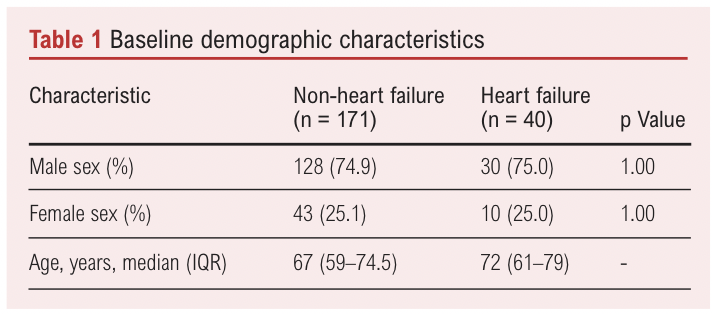

Baseline demographic characteristics were similar between the groups, with comparable sex distribution (male: 75.0% in HF vs 74.9% in non-HF) and a higher median age in the HF cohort (72 years (IQR 61–79) vs 67 years (IQR 59–74.5)).
Of the 40 patients with HF, 27 (67.5%) had HFrEF and 13 (32.5%) had HFpEF. At the time of index bypass, nine patients (22.5%) were classified as NYHA functional class I, 16 (40.0%) as class II and 15 (37.5%) as class III. No patients were classified as NYHA class IV. Overall, 31 patients (77.5%) had NYHA class II–III symptoms at the time of surgery.
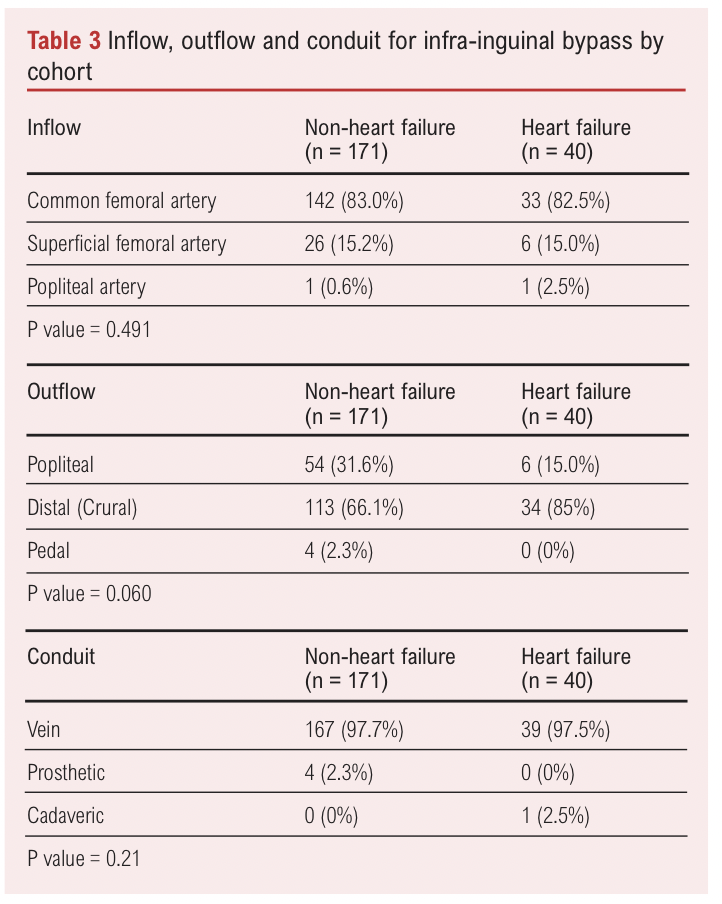
Patients with HF had a significantly higher comorbidity burden. The Charlson Comorbidity Index was higher in the HF group (median 7 (IQR 7–9) vs 5 (4–6)). Ischaemic heart disease was almost universal in the HF cohort (97.5% vs 28.1%). HF patients also had higher rates of diabetes mellitus (65.0% vs 39.8%), chronic lung disease (30.0% vs 17.0%), cerebrovascular disease (22.5% vs 12.9%) and advanced chronic kidney disease (stage 4/5: 7.5% vs 1.2%). Summary data regarding bypas details and conduit can be seen in Table 3.
Follow-up
Median follow-up was calculated via reverse Kaplan–Meier analysis and found to be similar across the two groups: 46 months in the HF cohort compared with 45 months (95% CI 42 to 52) in the non-HF cohort (p=0.68).
Graft outcomes
Competing risk analysis showed no significant difference (p=0.365) in the cumulative incidence of graft occlusion between HF and non-HF patients, with similar graft durability observed when accounting for death and major limb amputation as competing risks (Figure 1). Furthermore, graft reintervention rates were similar, with 16 (40.0%) undergoing graft reintervention in the HF cohort and 60 (35.1%) in the non-HF cohort (p=0.59).

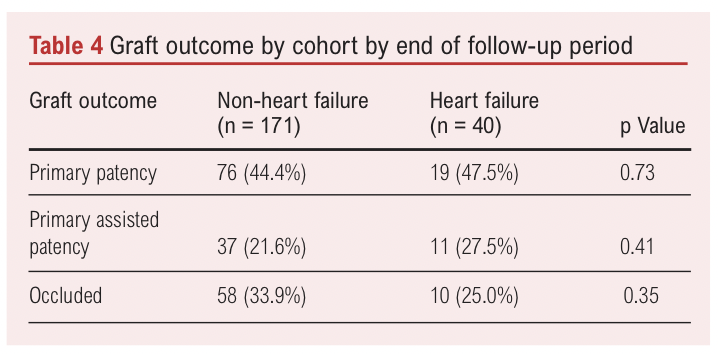
Graft status at the end of follow-up was comparable between patients with and without HF. Primary patency was achieved in 19/40 (47.5%) patients in the HF cohort compared with 76/171 (44.4%) in the non-HF cohort, while primary-assisted patency was observed in 11/40 (27.5%) and 37/171 (21.6%), respectively. Graft occlusion occurred in 10/40 (25.0%) patients with HF compared with 58/171 (33.9%) without HF. There was no significant difference in the overall distribution of graft status between the two cohorts (Table 4).
Survival and limb outcomes
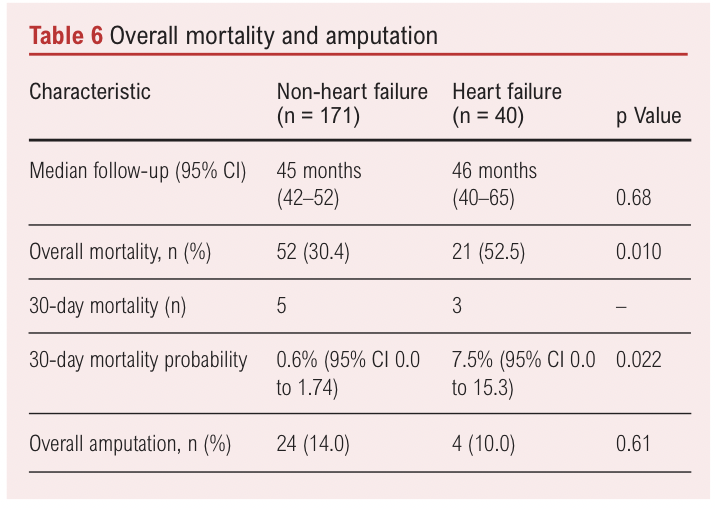
Overall mortality was significantly higher in patients with HF (52.5% vs 30.4%, p=0.010). Overall amputation rates were similar between the two groups (10.0% in HF vs 14.0% in non-HF, p=0.61).
Kaplan–Meier analysis demonstrated significantly reduced overall survival in patients with HF compared with those without HF (Figure 2). One-year survival was 77.5% (95% CI 65.6% to 91.6%) in the HF cohort compared with 98.1% (95% CI 96.1% to 100%) in the non-HF cohort, declining to 57.0% (95% CI 41.3% to 72.7%) and 84.3% (95% CI 78.3% to 90.8%), respectively, at three years (Table 5). Survival distributions differed significantly between cohorts (log-rank p<0.001). On Cox regression analysis, HF was associated with an increased hazard of mortality following infra-inguinal bypass (HR 2.44, 95% CI 1.47 to 4.06; p<0.001). Median survival was 46 months (95% CI 22 to NA) and 64 months (95% CI 53 to 68) in the HF and non-HF cohorts, respectively.

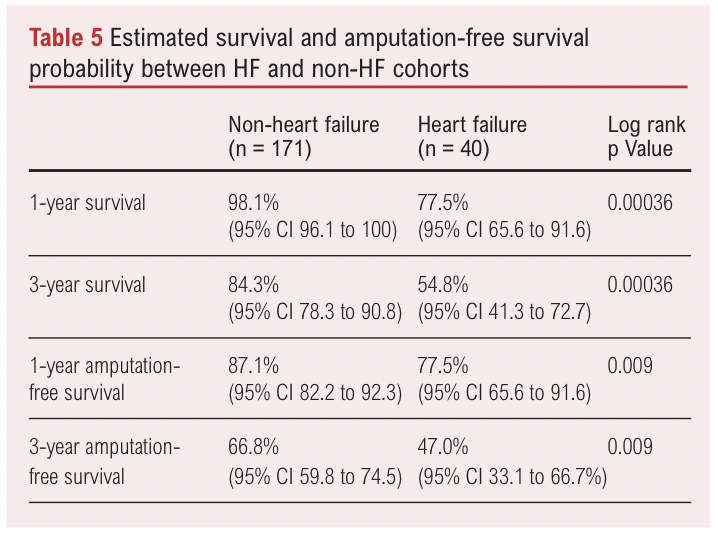
AFS was also significantly lower in patients with HF (Figure 3). One-year AFS was 77.5% (95% CI 65.6% to 91.6%) in the HF cohort compared with 87.1% (95% CI 82.2% to 92.3%) in the non-HF cohort, declining to 47.0% (95% CI 33.1% to 66.7%) and 66.8% (95% CI 59.8% to 74.5%), respectively, at three years (Table 5). The difference in AFS between cohorts was statistically significant (log-rank p=0.009). HF was associated with an increased hazard of the composite endpoint of major amputation or mortality (HR 1.87, 95% CI 1.16 to 3.00; p=0.010). Median AFS was 33 months (25 to NA) and 64 months (53 to NA) within the HF and non-HF cohorts, respectively.

Thirty-day mortality was also higher in patients with HF at 7.5% (95% CI 0.0% to 15.3%) compared with 0.6% (95% CI 0.0% to 1.74%) in the non-HF cohort (p=0.022). Summary data of overall mortality and amputation rate is summarised in Table 6).
Discussion
Main findings
This study demonstrates that infra-inguinal bypass for CLTI does not appear to be associated with a significantly impaired graft durability in patients with and without HF. However, HF was associated with a substantially increased comorbidity burden and overall mortality despite comparable rates of limb loss and graft occlusion. These findings suggest that HF represents an important marker of systemic and perioperative risk in patients undergoing infra-inguinal bypass, without necessarily compromising the durability of the bypass itself.
Interpretation of mortality findings
The significantly higher overall mortality observed in patients with HF is likely to reflect their greater cardiovascular disease burden and higher prevalence of systemic comorbidity, as evidenced by the higher median Charlson Comorbidity Index. HF was associated with more than twice the hazard of mortality during follow-up (HR 2.44, 95% CI 1.47 to 4.06; p<0.001).
The increased mortality was apparent early after surgery, with divergence of the Kaplan–Meier curves during the perioperative period. These findings are consistent with contemporary evidence demonstrating an association between HF and adverse outcomes following lower extremity revascularisation. In a contemporary cohort of patients with CLTI undergoing infra-inguinal revascularisation, HF was an independent negative predictor of AFS, with particularly poor outcomes among patients with HFrEF.7 Similarly, a large analysis demonstrated that moderate-to-severe congestive HF was associated with increased 30-day and 3-year mortality following lower extremity bypass for CLTI.8
The present findings therefore reinforce the importance of recognising HF as a significant perioperative and long-term prognostic factor in this population. Identification of HF should inform perioperative risk assessment, optimisation of cardiovascular status, anaesthetic planning and patient counselling, particularly given the substantial mortality observed despite successful limb revascularisation. It is likely that it is not the mere prevalence of HF alone which leads to increased mortality, but the management of HF and its associated comorbidities pre- and postoperatively which lead to adverse outcomes.
Limb and graft outcomes
Despite the increased mortality observed in patients with HF, graft outcomes were not significantly impaired. Competing risk analysis showed no significant difference in the incidence of graft occlusion when accounting for death and major amputation. This suggests that HF may not adversely affect conduit performance or the technical durability of infra-inguinal bypass at a clinically significant level.
These findings are particularly relevant when considered alongside contemporary studies. In the study by Lin et al moderate-to-severe congestive HF was associated with increased mortality following lower extremity bypass but was not associated with a significant difference in major amputation or reintervention during mid-term follow-up.8 Similarly, Inoue et al demonstrated poorer AFS among patients with HF undergoing infra-inguinal revascularisation, although their analysis included both endovascular and bypass procedures and focused primarily on survival and limb outcomes rather than graft-specific durability.7
Our study therefore adds to the existing literature by providing detailed graft surveillance data within a dedicated infra-inguinal bypass cohort. The preservation of graft patency and absence of a significant difference in graft occlusion suggest that the excess mortality associated with HF is not necessarily accompanied by impaired conduit durability. This distinction is clinically important as it indicates that the principal adverse prognostic effect of HF may relate to patient survival rather than failure of the revascularisation itself.
Although AFS was lower in patients with HF, the magnitude of the difference was less pronounced than that observed for overall survival. HF was associated with an increased hazard of amputation or death. The greater disparity in overall survival than in graft-related outcomes, together with the comparable incidence of graft occlusion, suggests that excess mortality makes an important contribution to the reduction in AFS observed in the HF cohort.
Nevertheless, the observed AFS following bypass should be considered in the context of the poor natural history of untreated CLTI. Established data suggest that approximately 60% of patients with untreated CLTI remain amputation-free at one year.9 In the present cohort, AFS among patients with HF was 77.5% at one year and 47.0% at three years. While direct comparison between cohorts may be inappropriate given differences in patient selection and study methodology, these findings suggest that revascularisation may still provide meaningful limb-related benefit in appropriately selected patients with HF.
This is particularly relevant given the poor prognosis associated with major lower limb amputation. Major amputation in patients with CLTI is associated with substantial subsequent mortality, estimated at approximately 29% at one year and 63% at five years, with a reported median survival of 3.1 years.10 In the present study, median overall survival in patients with HF was 46 months (95% CI 22% to not reached). It is important to note the lack of precision with this confidence interval due to the relatively small HF cohort, and interpretation should be met with caution. Although these outcomes cannot be directly compared, they provide important context when considering the balance between the risks of revascularisation and the consequences of limb loss.
Clinical implications
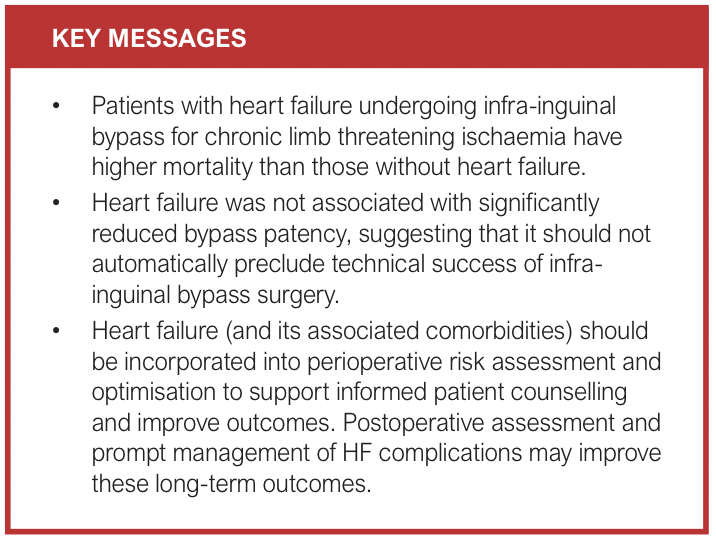
These findings suggest that HF should not necessarily be interpreted as a marker of clinically significant poor graft durability or technical failure following infra-inguinal bypass. Instead, HF identifies a population at substantially increased risk of perioperative and longer-term mortality. Surgery is known to have potential to acutely exacerbate chronic medical conditions such as decompensation of chronic HF. Consequently, the presence of HF should be incorporated into perioperative risk assessment and patient counselling, with appropriate attention to cardiovascular optimisation, anaesthetic planning and postoperative management.
CLTI often requires urgent revascularisation and may not allow time for complete optimisation of chronic medical comorbidity in the interest of limb salvage. This highlights further the importance of medical management of HF and co-existing comorbidity in the postoperative period, which could positively impact long-term outcomes.
Importantly, these findings do not support HF as an independent contraindication to infra-inguinal bypass in appropriately selected patients. Where limb salvage remains the treatment objective, the potential benefits of durable revascularisation should be weighed against the increased systemic risk associated with HF. This approach may allow cardiovascular risk to be optimised without unnecessarily excluding patients from a procedure that can achieve satisfactory graft durability and potentially meaningful limb preservation.
Limitations
This study has several limitations. First, its retrospective observational design introduces the potential for selection bias and residual confounding. The HF cohort had a significantly greater overall comorbidity burden, particularly a higher prevalence of ischaemic heart disease, which may contribute to the observed difference in mortality and limits attribution of the excess risk specifically to HF. Although the association between HF and mortality was strong, the observational design precludes inference of a causal relationship.
Second, the relatively small number of patients with HF limits the statistical power of subgroup analyses according to HF phenotype and severity. In particular, comparisons between HFrEF and HFpEF and analyses according to NYHA functional class should therefore be interpreted cautiously. Small cohort size may have implications on graft patency data. Finally, the study was conducted within a single vascular network and may not be fully generalisable to centres with different patient populations, operative practices or postoperative surveillance protocols.
Conclusions
Infra-inguinal bypass surgery in patients with HF is not associated with a significantly higher probability of future graft occlusion, but is associated with a substantially increased comorbidity burden and mortality. These findings suggest that HF may primarily influence systemic survival rather than graft durability following bypass surgery. HF should therefore be incorporated into preoperative risk assessment and patient counselling, with identification of HF prompting targeted optimisation and multidisciplinary perioperative planning to mitigate risk. It is also important to note that the co-existing increase in medical comorbidities should also be optimised in a similar manner.
HF alone should not be considered an independent contraindication to the technical success of infra-inguinal bypass in appropriately selected patients.
Article DOI:
Journal Reference:
J.Vasc.Soc.G.B.Irel. 2026;Online ahead of publication
Publication date:
November 23, 2026
Author Affiliations:
Wessex Vascular Network, University Hospital Southampton NHS Foundation Trust, Southampton, UK
Corresponding author: Thomas G Baker Wessex Vascular Network, University Hospital Southampton NHS Foundation Trust, Southampton, SO16 6YD, UK Email: Thomas.baker@ doctors.net.uk